
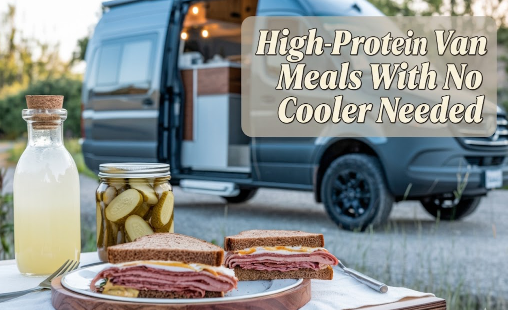
The first few months I lived on the road, I ate like I was perpetually one meal away from running out of options. Every time I needed protein, I reached for eggs or chicken, both of them sitting in a small cooler that drained more battery than I’d like to admit, leaked all over my van floor at least twice, and ran out of ice reliably every third day without fail.
I assumed protein meant cold. That was the mistake.
It took me longer than I want to admit to figure out that the most reliable protein sources in a van kitchen aren’t in a cooler at all. They’re in a cupboard. Shelf-stable, space-efficient, and honestly more versatile than a block of chicken breast that needs using up before tomorrow afternoon.
This is about eating well, actually eating well, without a fridge, a cooler, or any cold storage whatsoever. Not survival food. Not sad canned tuna eaten straight from the tin on a folding chair. Proper, satisfying meals that keep you full, keep your nutrition in a reasonable range, and don’t turn your van into a daily food anxiety situation.
1. The Assumption That Cost Me a Week of Bad Meals
Most people carry this into van life quietly. It makes sense. In a house kitchen, the high-protein foods, chicken, fish, eggs, yogurt, cottage cheese, all live in the fridge. That’s just where protein lives, apparently.
But that framing comes from abundance. From having a full-size refrigerator with a deli drawer and enough space to lose things behind the leftovers.
Van cooking strips that back. And when it does, people tend to fall into one of two bad habits. Either they install a portable fridge that quietly destroys their electrical system, or they start eating fast food three times a day because “there’s no way to eat properly without refrigeration.” Neither is true. Neither is necessary.
The reality is that some of the most protein-dense foods available require zero cold storage. Dried lentils. Tinned sardines in olive oil. Chickpeas. Hemp seeds. Hard aged cheese. Nut butters. Dried edamame. TVP, which stands for textured vegetable protein and sounds clinical but cooks remarkably like ground meat.
None of those need a cooler. All of them cook quickly on a single burner. And most of them cost considerably less than fresh meat.

2. The Shelf-Stable Proteins Worth Building Around
Not every shelf-stable protein behaves the same way. Some are high in protein but nutritionally thin everywhere else. Some are calorie-dense in a way that catches you off guard. And some are genuinely versatile, while others are a one-trick ingredient you’ll tire of quickly.
After a lot of road testing and a few meals I’d rather quietly forget, here are the ones I keep in rotation at Van Life Kitchen:
Tinned fish. Sardines, mackerel, and tuna in olive oil. Not water-packed. The oil keeps them moist and makes them function well in pasta, tossed with chickpeas, or over couscous with lemon. A 120g tin of sardines delivers roughly 23g of protein. Good-quality tinned mackerel has no business being as delicious as it is, and it keeps for years without any thought.
Dried and tinned legumes. Red lentils cook in 20 minutes with no soaking whatsoever. Tinned chickpeas and black beans need about two minutes: drain, rinse, done. Both sit around 15-18g of protein per cooked cup, and they absorb whatever seasoning you throw at them. That matters a lot when you’re working from a small spice kit.
Textured vegetable protein (TVP). This is the ingredient most people haven’t tried. Dehydrated soy protein that you rehydrate in hot water or broth, it absorbs seasoning, firms up nicely, and works as a ground-meat substitute in almost any context. One dry cup has around 24g of protein and costs almost nothing. It’s underused in van kitchens, and I don’t understand why.
Pumpkin seeds and hemp hearts. These are addition proteins, things you scatter rather than build a meal around. But pumpkin seeds carry 9g per 30g serving, and hemp hearts have a complete amino acid profile, which is rare for a plant source. I keep a small jar of each. They go on everything.
Hard aged cheese. This one surprises people. A proper aged parmesan or a hard manchego doesn’t require refrigeration for days, sometimes weeks in cool conditions. Twenty grams gives you 7-8g of protein, and it makes almost any simple van meal taste considerably better.
Here’s a quick reference for what you’re actually working with:
| Protein Source | Approx. Protein per Serving | Shelf Life (Unrefrigerated) | Notes |
|---|---|---|---|
| Tinned sardines (120g) | 23g | 2-5 years | Oil-packed far better than water |
| Dried red lentils (1 cup, dry) | 18g | 1-2 years | No soaking, 20-min cook |
| Tinned chickpeas (1 cup) | 15g | 2-3 years | Ready to use, rinse first |
| TVP (1 cup, dry) | 24g | 1+ year | Rehydrate in hot water or broth |
| Pumpkin seeds (30g) | 9g | 6-12 months | Scatter over any meal |
| Hemp hearts (30g) | 10g | 6-9 months | Complete amino acid profile |
| Aged hard cheese (30g) | 7-8g | Days to weeks | Temperature-dependent |
| Natural nut butter (2 tbsp) | 7-8g | 3-6 months | Choose oil-separated varieties |
3. How to Actually Cook These in a Van
Having a shelf full of shelf-stable protein doesn’t automatically produce good food. That part still requires some thinking. The structure that works best, in my experience, is what I’d call base-plus-protein-plus-flavour. It sounds obvious, but having the formula prevents the “I have all these ingredients and nothing to make” paralysis.
Pick a base: rice, pasta, couscous, or quinoa. Couscous gets underused here because it doesn’t feel like a real cooking effort. It isn’t really. Boil water, pour it over, wait five minutes while you sort everything else out. That’s it.
Then pick a protein from the shelf. Then add flavour: onion and garlic (fresh or dried both work fine), a spice combination, tinned tomatoes, or a stock cube dissolved in hot water.
Red lentil dal takes about 25 minutes total. Soften a small onion and some garlic in oil, add a teaspoon each of cumin and turmeric, throw in a cup of rinsed red lentils, pour in 400ml of water with half a vegetable stock cube, and let it simmer until the lentils break down completely. That’s the whole recipe. It has around 18g of protein per serving, costs roughly 80 cents to make, and genuinely keeps you full for hours.
Or a TVP stir-fry. Rehydrate a cup of TVP in hot water with a splash of soy sauce and garlic powder. Drain it, fry it in a pan with whatever vegetables are available: tinned sweetcorn, dried mushrooms, diced onion. Serve over rice. High protein, high flavour, under ten minutes once the TVP has had time to rehydrate.
These aren’t technically demanding. They do require breaking the habit of thinking “I need meat for this to be a proper meal.” That habit is expensive and fridge-dependent. These meals are neither.
If you’re still working out what cooks well in a small space, the 10 easy van life kitchen recipes I cook on repeat in tiny spaces is worth keeping open. Several of them are built around shelf-stable proteins exactly as described here.

4. Where People Usually Get This Wrong
The most common mistake, and the one I made at the start, is thinking in meal replacement mode rather than ingredient mode.
In practice, it looks like this: someone buys a case of protein bars and a tub of powder because both are technically shelf-stable and high in protein. They stock up before a long drive, eat bars for two meals in a row, and end up bored and slightly nauseous and at a motorway services by day two.
Protein bars are fine as a backup. They are not a cooking system.
The second thing people get wrong is ignoring fat alongside protein. Shelf-stable proteins like lentils and TVP are genuinely low in fat, which means meals built entirely around them can leave you hungry again within an hour. This is where tinned fish in olive oil helps, or a spoon of nut butter stirred into a curry. Fat carries both flavour and satiation, it’s not optional.
Third, and this is a smaller point but it matters, people consistently under-season shelf-stable proteins. Lentils and chickpeas are neutral in a way that actually demands more seasoning than meat does. They need cumin. They need acid, a squeeze of lemon, a splash of vinegar, something. A stock cube dissolved into the cooking water. If your first attempt at a lentil dish was flat and forgettable, the issue almost certainly wasn’t the ingredient. It was the seasoning.
I’ve covered a lot of the underlying principles for cooking properly in a small space over on the 9 proven van life kitchen tips I learned the hard way, and seasoning comes up there too. Small adjustments, genuinely significant difference.
One more practical thing: propane. Dried lentils need 20 minutes of simmering. Tinned chickpeas need two. If you’re rationing gas between supply points, knowing which proteins are quick to cook matters just as much as knowing which are high in protein. And if budget is part of the equation too, the 7 smart van life kitchen budget hacks goes into propane usage in some detail, worth a look if you’re trying to stretch your setup further.
5. This Isn’t Compromise Cooking
There’s a tendency, in van life circles and food circles generally, to treat anything that doesn’t involve fresh ingredients as “making do.” Like you’re settling for something. Like the real version of the meal has chicken in it and this is the backup.
That framing is inaccurate and slightly irritating.
Dried lentils have fed people extremely well for thousands of years. Tinned sardines are how coastal communities preserved one of the most nutrient-dense fish available, long before refrigeration was an option. These aren’t emergency rations, they’re foundational foods, and some of the most reliable, affordable, and nutritious things you can cook.
On the road, where simplicity genuinely matters, shelf-stable proteins reduce a specific kind of mental load. You’re not calculating whether the cooler ice lasted through the night. You’re not racing to use up chicken before it turns. You’re not mapping your route around grocery store access every 48 hours.
Your van kitchen gets quieter. More predictable. That’s not a trivial thing when you’re also navigating, parking, working, and trying to actually be present in the places you’re driving to.
For days when you want something a bit more substantial, the 6 personal van life kitchen dinners I make every week includes a few recipes that bridge shelf-stable and fresh without depending on full refrigeration.
Most of my best road meals came from a 40-litre shelf in the back of the van. No cooler. No drama. Just good food that was ready when I needed it.
Frequently Asked Questions
Can you realistically hit your daily protein target without meat or eggs on the road?
Yes, with a bit of attention to combining sources across the day. Lentils and rice together form a complete amino acid profile. Hemp hearts are one of the few plant proteins that are complete on their own. You don’t need to calculate this obsessively at every meal. Reasonable variety over the course of a day covers most needs for most people. A day with tinned sardines at lunch, a cup of cooked lentils at dinner, and a handful of pumpkin seeds scattered over things puts you above 65g of protein without a single refrigerated item.
How long can tinned fish actually last once you’ve opened it?
Once opened, eat it within a day. The practical solution is buying tins in single-meal portion sizes. Individual sardine tins or small mackerel fillets work well for van life because there’s nothing to store after. Tinned fish in oil will keep a few hours at room temperature if needed, but there’s little reason to stretch it.
Is TVP worth buying if I’m not vegan or vegetarian?
Yes, regardless of diet. TVP is cheap, keeps for over a year, takes on whatever seasoning you use, and adds meaningful protein to simple meals without requiring any animal product aversion. Think of it less as a meat substitute and more as a neutral high-protein ingredient that behaves a lot like minced meat in a bolognese or fried rice. Most people who try it once start keeping it in the van permanently.
Does hard cheese genuinely not need refrigeration?
Properly aged hard cheeses like parmesan, pecorino, manchego, and aged gouda have low enough moisture content that they keep well unrefrigerated for several days, sometimes longer in cool conditions. Wrap in parchment or wax paper rather than cling film, which traps moisture. Avoid anything soft, fresh, or labelled “young.” In summer heat, use within two or three days. If the outside surface starts looking dry but the inside smells fine, it’s still fine. Use your judgment.
What’s the biggest mistake van cooks make when switching to shelf-stable proteins?
Under-seasoning. Lentils, chickpeas, and TVP are all fairly neutral, and they need more seasoning than most people give them, especially salt, acid, and fat. A stock cube in the cooking water, a squeeze of lemon at the end, a drizzle of olive oil or a spoon of nut butter stirred in: those small additions are what separate a bland bowl from a meal you’d actually look forward to cooking again. The ingredient isn’t the problem. The seasoning nearly always is.
Van Life Kitchen is a resource for practical, honest cooking from the road. If you’re building out your van kitchen or looking for meals that work without the fridge, the recipe and tips sections are worth exploring.