

The smell of bread baking is the one thing I missed most when I first moved into the van.
Not a proper shower. Not a full-size chopping board. Not even a couch. It was bread. Fresh bread pulled from an oven, with that particular crust that only comes from steam and high heat and patience. The kind that makes the whole house smell like something good is happening.
I grew up learning to cook from my Nonna, and she baked bread every single week without fail. That ritual, the mixing and folding and waiting, the careful shaping before the loaf went in, I always assumed it required a real kitchen. Four walls. A proper oven. A countertop that didn’t fold out and back in again.
For the first three years on the road, I convinced myself baking bread in a van was impossible. Then last March, parked outside a small village in Abruzzo with nothing but rain and time and half a bag of flour, I decided to actually find out. Not read about it. Not watch a video. Just try.
This is what a week of van bread baking actually taught me.
1. Why the Oven Is the Real Problem
Bread needs heat. Consistent, enclosed, dry heat, ideally around 220-240°C for the first stretch of the bake, then dropping to carry the loaf through. That’s not news to anyone who bakes. What most van cooking write-ups don’t say clearly enough is that the heat isn’t just about cooking the dough. It creates steam. It sets the crust. It drives the final rise, that last explosive push called oven spring, which splits the scored top and gives bread the open crumb everyone’s after.
A gas hob on its own is useless for bread.
So the real question isn’t whether you can bake bread in a van. It’s whether you can replicate the conditions bread actually needs using what fits in a 60-square-foot kitchen. Two options genuinely work: a cast iron Dutch oven over the hob, or a stove-top oven like the Omnia. Both create an enclosed environment. Both trap steam in the early stages. Both produce real bread, not just cooked dough.
I started the week with the Dutch oven. Day one was a disaster, and I’m going to tell you exactly why, because it’s the kind of thing that stops people from ever trying again.
2. The Kit I Ended Up Using
By day two I had a clearer picture of what was actually required. Not just the baking vessel, but the full setup that makes any of it work reliably. Here’s what ended up being essential:
VAN BREAD BAKING: WHAT YOU ACTUALLY NEED
-----------------------------------------------------------
Heat source         | Gas hob with reliable, adjustable flame
Baking vessel       | Cast iron Dutch oven (4L+) or Omnia stove-top oven
Diffuser plate      | Sits under the pot, prevents scorching the base
Dough scraper       | Flexible plastic, for working on small surfaces
Pastry board        | Non-slip, keeps flour from going everywhere
Proofing method     | Closed van parked in sun, or near a warm engine vent
Digital thermometer | Check internal bread temp (93-96°C = done)
Timer               | Dedicated, not your phone. Flour and phones don't mix.
Getting proofing right was the problem I didn’t anticipate. In a proper kitchen you’d use a proving drawer, or a warm oven set to around 28°C. In the van, you’re working with ambient temperature and whatever the weather decides to do that day. That morning in Abruzzo it was about 10°C outside and barely warmer inside, and my first dough sat there looking exactly the same after two hours.
The fix I landed on was parking the van in a patch of sun for twenty minutes with all the windows closed, then putting the covered bowl inside. It turned the van into a mildly impractical proving chamber. Not elegant. Genuinely worked.
For anyone building out a van kitchen from scratch, the Van Life Kitchen gear guide covers the foundation pieces well. I’d have saved myself some frustration in my first year if I’d read something like that early on.
3. The Week, Attempt by Attempt
Day 1: Too much heat, not enough patience.
Simple white loaf in the Dutch oven. I got the flame too high because I was impatient and convinced that if it wasn’t screaming hot, nothing would happen. The base scorched in the first fifteen minutes. The inside was still raw when I opened the lid. The top looked perfectly fine. The bread looked like bread. It tasted like disappointment and slightly burnt cast iron.
Lesson: cast iron retains and concentrates heat aggressively. Over a gas flame, you need a diffuser plate underneath and a lower flame setting than feels sensible. If it sounds like frying, it’s too hot.
Day 2: No-knead dough, and finally something edible.
Switched to a no-knead recipe, which is well-suited to a van for two reasons. First, it doesn’t require a surface you can lean your whole weight on. Second, the long ferment means the dough does its work while you’re driving, sleeping, or sitting outside pretending that watching hills is productive.
I mixed the dough at night, around 16°C inside the van, and left it covered for about 18 hours. The result was genuinely good. Chewy crumb, reasonable crust, a little dense because of the cool fermentation, but nothing that ruins a meal. Sliced it with olive oil and called it dinner.
Day 3: First attempt with the Omnia.
The Omnia stove-top oven is a ring-shaped aluminium baking tin that sits over a gas hob and uses convection to bake. It’s genuinely clever. You can make bread, cakes, frittata, and things that have absolutely no business existing in a van kitchen. The instructions are straightforward and the results are consistent, which is rare.
But bread in the Omnia bakes in a ring shape because of the mould design, which means structurally it’s closer to a large bread roll with a hole in the middle than a proper loaf. The crust is softer because the sides cook against metal. Still good, just different. Worth knowing before you expect something that looks like what comes out of a proper oven.
Days 4 and 5: Focaccia. This was the turning point.
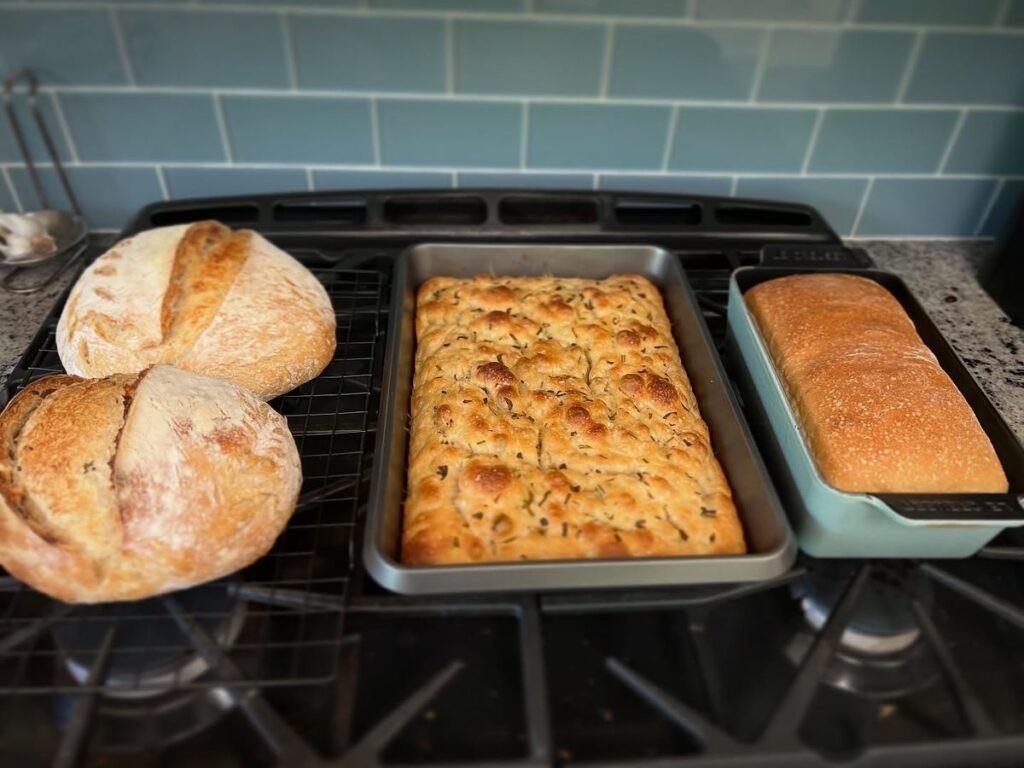
Focaccia is more forgiving than a lean bread because the olive oil in the dough creates margin for error in both heat and timing. I made it in a deep cast iron pan with a lid for the first half of the cook, removing it to crisp the top. Both days it came out well. Day five was actually properly good. Dimpled, salty, golden, the kind of thing you eat standing up over the pan without bothering to slice it.
If you’re testing van bread for the first time, start with focaccia. Not sourdough. Not a baguette. Focaccia.
Days 6 and 7: Back to the loaf.
With the diffuser situation sorted, the flame height calibrated, and the proofing method working, I went back to the white loaf that had failed on day one. Day six was decent. Day seven I finally got the oven spring I was after, that split along the score line, the slightly domed top, the open crumb when I cut into it. Not restaurant quality. But real bread. Bread you’d eat because you chose to.
4. Where People Usually Go Wrong
I’ve talked to a fair few vanlifers who tried baking once and gave up. The failure points are almost always the same ones.
No diffuser plate. Cast iron directly on a gas hob creates a hotspot right at the center of the base. The bread scorches there while the rest of the loaf is still raw. A diffuser plate costs a few pounds and fixes this completely. It’s the single thing that separates a burned loaf from an edible one, and almost nobody mentions it.
Using recipes written for domestic ovens. A fan oven at 230°C is not the same environment as a covered Dutch oven over a low flame. Time and temperature don’t transfer directly. You’re generally looking at a longer, lower bake using the van method, and you should check the internal temperature rather than going by how the outside looks. Done is 93-96°C internally, not “golden brown.”
Cold dough, impatient baker. A cold van means cold flour, cold water, sluggish yeast. What takes 90 minutes to proof in a warm kitchen can take three or four hours in a cold van. Rushing it gives you flat, dense bread that doesn’t recover in the oven no matter how long you bake it. Temperature is the variable most people ignore, and it matters more than almost anything else.
Starting with sourdough. I get it. Sourdough is satisfying. But a starter needs consistent temperatures to stay active, which is genuinely difficult in a vehicle that’s moving through different climates. Starting a sourdough project in a van during your first month is like learning to ride a bike on a mountain. Commercial yeast first. Always.
And one that catches people off guard: condensation. Baking produces moisture. A lot of it. If you’re not venting the van while you bake, that moisture settles everywhere, inside cabinets, under the mattress, behind panels. Open a window or roof vent every time the heat’s on. This seems basic, but it’s the kind of thing you don’t think about until you’ve already got a mould problem in a small enclosed space, which is much worse than it sounds.
A lot of these same lessons apply broadly to cooking in small spaces. Van Life Kitchen has a solid piece on the hard-learned kitchen tips that covers similar ground if you’re putting a van setup together from scratch.
5. So, Can You Actually Do It?
Yes. Unambiguously yes.
But it takes more attempts than one, more prep than a standard one-burner setup allows, and a tolerance for failure that the romantic version of van life cooking doesn’t always include in the brochure. The first loaf will probably be terrible. The second might not be much better. By the fourth or fifth attempt you start to understand what your specific setup can do, and that knowledge is worth more than any recipe.
The baking changed something for me, and I realize that probably sounds like a stretch, but it made the van feel more like a kitchen. Not just a place to heat things. A place where something could actually be made from scratch, with flour and patience and a few mistakes.
That particular smell came back. The one from my Nonna’s kitchen. The one I thought I’d given up when I traded four walls for wheels.
Parked in Abruzzo with a passable loaf cooling on the dashboard wrapped in a tea towel, that felt like plenty.
If you’re building out your van kitchen and thinking through what gear actually earns its space, Van Life Kitchen covers both the easy repeatable recipes worth having in your rotation and the budget-first setup strategies that keep the whole thing practical rather than expensive.
FAQs
Can I use a standard bread recipe in a Dutch oven on a gas hob?
Use it as a starting point, but expect to adjust. Domestic oven recipes assume high, dry, circulating heat. A covered Dutch oven over a low gas flame is slower and more humid, especially in the early stages. Reduce your dough hydration slightly (aim for around 68-72% rather than the higher ratios some recipes use), plan for a longer bake, and always check internal temperature rather than going by appearance. Done is 93-96°C in the center.
What bread should I make first in a van?
Focaccia or a simple no-knead white loaf. Both tolerate imperfect conditions better than lean, high-hydration breads. Focaccia especially, because the olive oil gives the dough flexibility and the final result is forgiving on heat. Once you understand how your specific heat source behaves, you can push toward more demanding recipes.
How long does dough take to proof in a cold van?
Depends on the temperature, but as a rough guide: at around 15-18°C inside the van, expect bulk fermentation to take 3 to 4 hours rather than the 1 to 2 hours a warm kitchen recipe suggests. The second proof after shaping can take 45 to 90 minutes. Don’t rush either stage. Underproofed dough goes into the oven and stays dense, and there’s nothing you can do to fix it after the fact.
Do I need an Omnia oven specifically, or will a Dutch oven do?
A cast iron Dutch oven with a lid works equally well for most loaves and is arguably better for traditionally shaped bread because it accommodates more dough volume and creates a stronger steam environment during the critical first stage of the bake. The Omnia earns its place if storage is tight, or if you want one tool that handles bread, cakes, and frittata. Neither is essential if you have the other.
Is sourdough realistic in a van?
Yes, but it’s a committed project. Maintaining a starter across different climates requires real attention. Some van bakers keep theirs in a small insulated bag to reduce temperature swings. Others bake with it often enough that it stays active regardless of where they are. It’s doable, but it’s not a beginner’s project, and not something to attempt during your first few months on the road. Get comfortable with commercial yeast first, then revisit.