
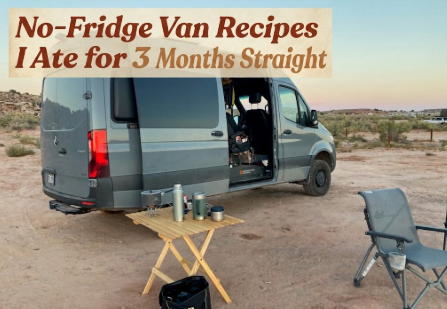
Somewhere on the outskirts of Naples, parked beside a dusty stone wall with the rear doors hanging open and a pot of chickpeas simmering on one burner, I realised I couldn’t remember the last time I’d actually missed having a fridge.
It had been over two months at that point. The compressor had gone somewhere in the south of France, around a week into what was supposed to be a six-week trip through Italy. Fixable eventually, but not soon and not cheap. I had two options: track down a repair shop and lose four or five days waiting, or adapt and cook smarter. I adapted. And then I kept adapting for another two and a half months after that, even when fixing it became a realistic option.
That’s the part that surprised me. The constraint turned out to be useful.
1. Why No-Fridge Cooking Is Actually Easier Than You Think
People assume that removing the fridge from the equation means crackers and peanut butter. Which, fair, that’s one version of it. But the versions I found myself cooking regularly were better than that. Not gourmet, but satisfying and genuinely real.
The fridge creates a certain kind of laziness in meal planning. You buy things, they go in cold storage, and sometimes they come out again before they go off. Sometimes they don’t. Without it, every ingredient I bought had a job to do within 48 hours. Onions, garlic, dried legumes, tins, olive oil, pasta, oats, spices. Nothing complex. Everything had to earn its spot.
There’s actually a detailed breakdown of van life kitchen budget systems over on Van Life Kitchen that covers how this kind of pantry thinking affects your grocery spend. The numbers there are worth reading before your next shop. Because when you stop relying on fresh perishables as your foundation, your weekly food costs change noticeably.
The other thing people underestimate is how flavourful shelf-stable cooking can actually be. Dried chickpeas that you soak yourself beat canned ones, and they cost a fraction of the price. Tinned tomatoes cooked down low and slow with good olive oil and garlic are genuinely excellent. Pasta from a packet doesn’t need much. Neither does a bowl of lentil soup with a handful of fresh herbs you grabbed at a market that morning.
No fridge doesn’t mean no fresh food. It just means being deliberate about it.
2. The Pantry That Made It All Work
The first week was the most chaotic. I was still thinking like someone with a fridge, reaching for things that weren’t there, shopping without a system. It took about seven days before a real structure clicked into place. After that, the same rough pantry setup carried me through most of the three months.
Here’s what I kept stocked at all times.
Dry goods: pasta (rigatoni and spaghetti mostly), rice, red lentils, dried chickpeas, oats, a bag of polenta.
Tins and jars: crushed tomatoes, cannellini beans, chickpeas for emergency quick meals, sardines, tuna packed in olive oil, tahini, coconut milk, a small jar of anchovies.
Aromatics: whole garlic bulbs (they last weeks when kept cool and dry), a mesh bag of onions, sometimes a fresh chilli or two from a roadside stall.
Spices and flavour: cumin, smoked paprika, dried oregano, chilli flakes, a small container of flaky salt, black pepper, a bottle of good olive oil that I treated like currency.
Quick-use fresh items: a lemon, a lime when I could find one, a bunch of flat-leaf parsley, and one or two vegetables I planned to use within a day or two. Courgettes, peppers, and spinach were the most reliable in terms of holding without cold storage.
What I didn’t bother keeping: anything that needed refrigeration once opened, or anything that required more than one pot to cook properly. Space was tight, and every item had to justify being there.
3. The Recipes That Made It into the Rotation
Not every meal I cooked was a winner, and I’m not going to pretend otherwise. There were a few grim evenings of overcooked lentils and underseasoned rice I’d rather forget. But the recipes below became regulars, the kind I was cooking on autopilot by the second month.
Quick-Reference: No-Fridge Van Recipes at a Glance
| Recipe | Base Ingredients | Cook Time | Burners Needed |
|---|---|---|---|
| Chickpea and tomato braise | Chickpeas, crushed tomato, garlic, smoked paprika | 25-35 min | 1 |
| Red lentil soup with cumin | Red lentils, onion, garlic, cumin, lemon | 20-25 min | 1 |
| Tuna pasta with anchovies | Tinned tuna, pasta, anchovies, capers, olive oil | 20 min | 1 |
| Polenta with oil and herbs | Polenta, olive oil, dried oregano, flaky salt | 15 min | 1 |
| Sardine rice bowl | Tinned sardines, rice, chilli flakes, lemon | 20 min | 1 |
| Coconut red lentil dhal | Red lentils, coconut milk, onion, cumin, chilli | 25 min | 1 |
Every single one of those runs on one burner. I was cooking on a single Campingaz setup for most of the trip, and it handled everything. The guide to van life kitchen gear picks covers why single-burner setups make more practical sense than they appear on paper, and I’d agree with most of that from experience.
The chickpea and tomato braise became something close to a weekly staple. You fry garlic in olive oil, add smoked paprika, let it bloom for thirty seconds, pour in the crushed tomatoes, add drained chickpeas, season properly, and let it cook down for twenty minutes. Eat it with bread if you have it, with rice if you don’t. The chickpeas were still warm one evening when I added them late, they had that slightly smoky edge from the paprika, and I ate the whole pot sitting in the back of the van watching the sun drop behind a hill outside Matera.
And the coconut dhal, I cooked that more than anything else. Onion softened in oil, a heavy hand of cumin, red lentils rinsed and added, a tin of coconut milk topped up with water, cooked until thick and golden. About 25 minutes total. Costs almost nothing. Tastes like something you’d pay good money for in a restaurant.
The tuna pasta is worth mentioning because it tends to raise eyebrows. Tinned tuna in olive oil, not the watery kind, cooked through with anchovies and a spoon of capers, tossed through pasta with a little of the pasta water to loosen it. It’s briny, rich, and oddly satisfying. I probably ate it once a week for three months and never got tired of it, which surprised me.
4. Where Most People Get This Wrong
The number one mistake I see van lifers make when they try cooking without a fridge is that they try to recreate fridge-dependent meals without a fridge.
They plan a recipe that needs fresh chicken. Or a dish built around leftover roasted vegetables from the night before. Or something that relies on dairy in a meaningful way. And then when none of that works, they give up and say no-fridge cooking is too limited.
It isn’t. But it requires building a completely different recipe logic from the beginning.
Actually, let me rephrase that. It’s not even a different logic. It’s just cooking the way most of the world has cooked throughout most of history, with shelf-stable ingredients, fresh aromatics, and whatever came from the market that morning. What’s unfamiliar is the constraint. What you gain is clarity.
The second mistake is underestimating seasoning. Without the richness that fresh protein or dairy brings, your dried and tinned ingredients need more care. Salt at every stage. Acid at the end, lemon or a small splash of vinegar. Fat as a vehicle, not an afterthought. These are cooking fundamentals, but they matter more when your ingredient list is stripped back.
Van Life Kitchen has a collection of easy recipes worth cooking on repeat in small spaces, and the principle behind most of those applies here. Simplicity isn’t a compromise when the technique is right.
The third mistake, which I made myself in week one, is buying too many fresh vegetables in one shop thinking you’ll get through them all. You won’t. Buy one or two. Use them in the next meal. Go back to the market the next day if there’s one nearby. European markets are one of the genuinely great arguments for slow van travel, and I could write a whole separate post on that. Maybe I will. The point is: small, frequent, intentional.
5. What Three Months Actually Taught Me
By the time I got the compressor looked at properly, I wasn’t even sure I wanted to rush the repair.
The cooking had been simpler. The grocery bills had dropped. I’d stopped wasting food almost completely, which is something I’d never quite managed with a fridge. And some of the meals, the best ones, had actually been better than what I’d been producing before, because I’d had to think harder about them.
There’s something about constraint that sharpens focus in the kitchen. My Nonna cooked with very little her whole life and produced food I’ve never been able to fully replicate with a full kitchen and professional equipment. That’s not a coincidence. Scarcity teaches technique in a way that abundance doesn’t, and the road has a way of reminding you of that whether you ask for the reminder or not.
If your fridge dies on you out there, don’t panic. Or if you’re building a van setup and wondering whether you really need one at all, it’s a question worth sitting with. You can eat well without it. Better than well. You just have to plan your meals around the ingredients you actually have rather than starting from what a recipe tells you to buy.
The recipes I’ve listed above are the ones I’d go back to immediately. They’re not exciting on paper, but that’s not the point. On the road, in the back of a van, with the doors open and something good simmering, they’re exactly right.
FAQs
How long do tinned and dried ingredients realistically last in a hot van?
Most dried goods (pasta, lentils, oats, rice) are fine for months as long as they’re kept in sealed containers away from moisture. Tinned goods last years unopened. The one thing to watch in hot climates is cooking oil, which can go rancid faster than you’d expect in a warm interior. Buy smaller bottles and use them up within a few weeks.
What’s the single most useful piece of cookware for no-fridge van cooking?
A deep, wide 24cm saucepan or a shallow casserole-style pot. It handles soups, braises, pasta, and rice all in one vessel. You don’t need a collection of pans. You need one good one that you trust completely.
Can you eat enough protein on a no-fridge diet without relying on tinned meat all the time?
Absolutely. Red lentils and chickpeas are both solid protein sources and they’re cheap and shelf-stable. Tahini adds protein and fat in a useful way. Tinned sardines and tuna are brilliant if you eat fish. Eggs are also worth mentioning because they don’t need refrigeration for the first couple of weeks, and they’re one of the most versatile things you can cook on a single burner.
What about breakfast? Most ideas seem to assume you have a fridge.
Oats cover it almost entirely. Cooked oats with tahini and honey are filling, fast, and cost almost nothing. Tinned fruit mixed through oats if you want something different. Eggs on bread when you have a loaf. It’s simpler than most people expect, and honestly I never struggled with breakfast as much as with dinner.
Is this viable in very hot climates, like southern Europe in high summer?
Yes, with adjustments. The main change is that fresh aromatics need to be used faster, and anything you cook needs to be eaten the same day rather than saved and reheated. In heat, tinned and dried ingredients become more reliable, not less. I cooked without a fridge through a Sicilian July and managed fine. The key is shopping smaller and more often, which fits naturally with the market culture in that part of the world anyway.
There are plenty of days on the road when the simplest meal is the best one. A bowl of lentils, a piece of bread, a view you didn’t plan for. The fridge was never really the thing that made the food good.