
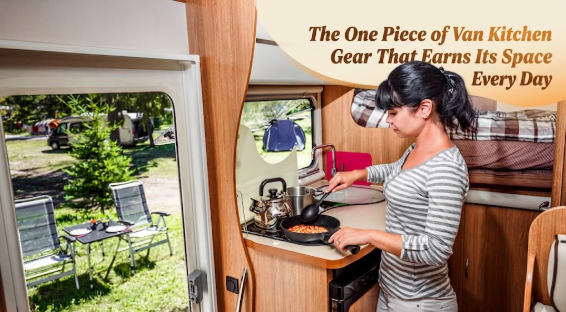
The non-stick pan you’re planning to bring into your van will be dead in eighteen months. Probably less.
That’s not pessimism. That’s what happens when a coating that degrades around 260°C meets a gas burner that comfortably exceeds that temperature on medium, used daily, cleaned in whatever water you have access to, stored in a vehicle that vibrates and shifts and sits in the sun. The cheap ones are gone in six months. The expensive ones make it to fourteen or fifteen if you’re careful. And then you’re back at a supermarket somewhere, buying a replacement, allocating the same counter space and weight budget all over again.
I spent the first full year of van life cycling through non-stick pans. I kept thinking the problem was the brand. It wasn’t. The problem was the category entirely.
The single best piece of gear in my van kitchen, the thing that earns its wall hook without asking me to compromise anywhere, is a 26cm De Buyer Mineral B carbon steel skillet.
Not cast iron. Not non-stick. Carbon steel.
1. The Assumption That Gets Van Cooks Into Trouble
Most pan advice for van kitchens comes from one of two places. The first says: keep it light, go non-stick, don’t add unnecessary weight. The second says: go cast iron, build your seasoning, accept the weight as the cost of real cooking. Both of these positions start from the wrong question. It comes up constantly, in comments and emails on Van Life Kitchen and in every van life forum worth reading, non-stick or cast iron, which one, and both camps are asking the wrong thing.
The question isn’t “what’s lightest” or “what holds heat best.” The question is: what do I cook with every single day for months at a stretch, across all kinds of meals and all kinds of conditions, and what pan handles all of that without asking me to babysit it?
Non-stick fails that question because the surface is temporary. You’re not buying a pan; you’re buying a pan with an expiry date already built in. Cast iron fails it in a different way. A Lodge 10.25″ cast iron skillet weighs 2.8 kilograms. That’s before food. In a van where weight sits in the same budget as water, gas, and every other item you’ve decided you need to carry, 2.8 kilograms is a real and ongoing penalty. I’ve gone back and forth on it, and I keep arriving at the same conclusion: that’s more than two large bottles of water, for a pan.
Carbon steel sits between them. And it sits there being genuinely better than both for the actual cooking that happens in a van.
2. What Carbon Steel Does That Nothing Else Does in a Van Context
Carbon steel is roughly 99% iron and 1% carbon. Cast iron runs at 2 to 4% carbon, which contributes to both its brittleness and its substantial weight. The lower carbon content in steel gives you a thinner, lighter pan that heats faster, distributes heat more evenly across the base, and tolerates high temperatures without any of the coating concerns you carry with a non-stick surface.
The De Buyer Mineral B in the 26cm size weighs around 1.5 kilograms. That’s close to half the weight of an equivalent cast iron pan. It comes with a factory beeswax coating that protects the surface until first use. Once you remove that and build a few layers of polymerized oil into the surface through regular cooking, it develops genuine non-stick properties for most everyday tasks. Eggs slide out cleanly. Fish fillets lift in one piece. And unlike any non-stick pan you’ve owned, that surface improves over time rather than degrading. Each cooking session adds something to it. After six months of daily use, the pan is noticeably better than it was on day one. After a year, it’s a different object entirely.
The heat tolerance is what unlocks real cooking in a van context. Non-stick coatings start to break down around 260°C, which a medium-high gas flame exceeds without effort. Carbon steel has no meaningful upper limit for domestic cooking, which means you can get a proper sear on meat, develop real char on vegetables, and use the pan directly on a camp stove outside when the mood takes you. The Mineral B also works on induction, which matters if your van setup ever changes or you’re spending time at sites with electric hook-up.
I’ve used the same pan almost every day for sixteen months. It cooked eggs in a layby in the Dolomites and seared lamb chops on a cliff road above the Dalmatian coast. It’s made the tomato and butter pasta I talked about in the one-pan van dinners piece more times than I can count. The surface is genuinely better now than when I bought it. And I haven’t bought a replacement pan in sixteen months. For someone cooking daily in a moving kitchen, that’s not a small thing.
3. Honest Comparison: Carbon Steel vs. The Alternatives
These are real assessments, not theoretical comparisons. I’ve owned all three types in the van at various points, so this isn’t guesswork.
| Carbon Steel | Non-Stick | Cast Iron | |
|---|---|---|---|
| Weight (26cm/10″) | ~1.5kg | ~0.9–1.2kg | ~2.8kg |
| Durability | Decades with basic care | 1–3 years | Decades |
| Non-stick performance | Excellent once seasoned | Excellent when new | Good once seasoned |
| High-heat tolerance | Excellent | Poor (degrades ~260°C) | Excellent |
| Works on induction | Yes | Depends on base | Usually yes |
| Reacts to acid foods | Yes (until well seasoned) | No | Yes (mild) |
| Needs drying after wash | Yes | No | Yes |
| Gets better with use | Yes | No | Yes |
| Cost (decent version) | £40–65 | £12–35 | £30–60 |
The non-stick wins on early maintenance simplicity and saves you 300 to 600 grams over carbon steel. Those are real advantages, and I’m not going to pretend otherwise. But they’re thin. The weight saving is less than half a litre of water. The maintenance difference disappears inside two weeks once drying the pan after washing becomes habit. Both of those advantages erode, and they erode at roughly the same rate as the non-stick coating itself.
For weekend trips or occasional van use, a good non-stick is perfectly adequate. For anything measured in weeks or months, the return on a carbon steel pan starts on day one and builds continuously from there.
4. Where People Get This Wrong
The first thing that catches people out is the initial seasoning, and the mistake is almost always the same: too much oil.
The process isn’t complex. Wash off the factory beeswax with hot soapy water (the only time soap will ever touch this pan), then dry it on a medium hob. Apply a very thin layer of a high smoke-point oil, flaxseed or sunflower both work well. Heat until it smokes, let it cool, repeat twice more. That’s it. But “thin” has to mean thin: the pan should look almost dry after wiping. People apply oil like they’re dressing a salad, end up with a sticky, uneven surface, and conclude the whole seasoning process is unreliable. It isn’t unreliable. They just used four times too much oil. Thin layers built gradually is the only rule that actually matters.
The second thing that trips people up is how acidic food interacts with the pan in the early months. Before the seasoning is deep and well-established, long simmers of tomato sauce or anything with a lot of wine or citrus will pick up a faint metallic quality and strip some of the surface in the process. This is temporary. After two or three months of regular cooking, it stops happening entirely. The practical workaround in the early period is simple: use a saucepan for long tomato-heavy simmers, deglaze with stock rather than wine, and leave the lemon-heavy dishes for later once the seasoning has had time to build. By month four or five, none of this applies anymore.
And then there’s the rust. Carbon steel rusts if left wet, especially in coastal environments or anywhere with real ambient humidity. The habit to build is this: wash the pan, put it back on the hob at a low heat for two minutes until the water evaporates, wipe on a thin film of oil, put it away. That’s forty-five seconds. People who miss this step for a few consecutive days find orange patches and panic. The fix is simple enough: coarse salt and oil paste, scrub, dry, re-season. Better not to need it. There’s a parallel here to what the batch cooking without a freezer guide covers on Van Life Kitchen: the things that work best in a van kitchen almost always run on a small, consistent daily habit rather than a one-off fix.
I’ll admit there’s something slightly philosophical here, and I’m aware this is a tangent, but bear with me for a moment. When I started van cooking I wanted all my gear to be passive. Things that just worked, no thought, no maintenance, no learning curve. What I actually found is that the cooking I’m most satisfied with comes from tools that ask something small from me and return it noticeably in the result. The carbon steel pan is the clearest example of that pattern. And it’s the same reason I keep a decent knife sharp, keep the pantry stocked ahead of off-grid stretches, and don’t cut corners on the stuff that actually gets used daily.
Anyway. Back to the pan.

5. What Daily Use Actually Looks Like
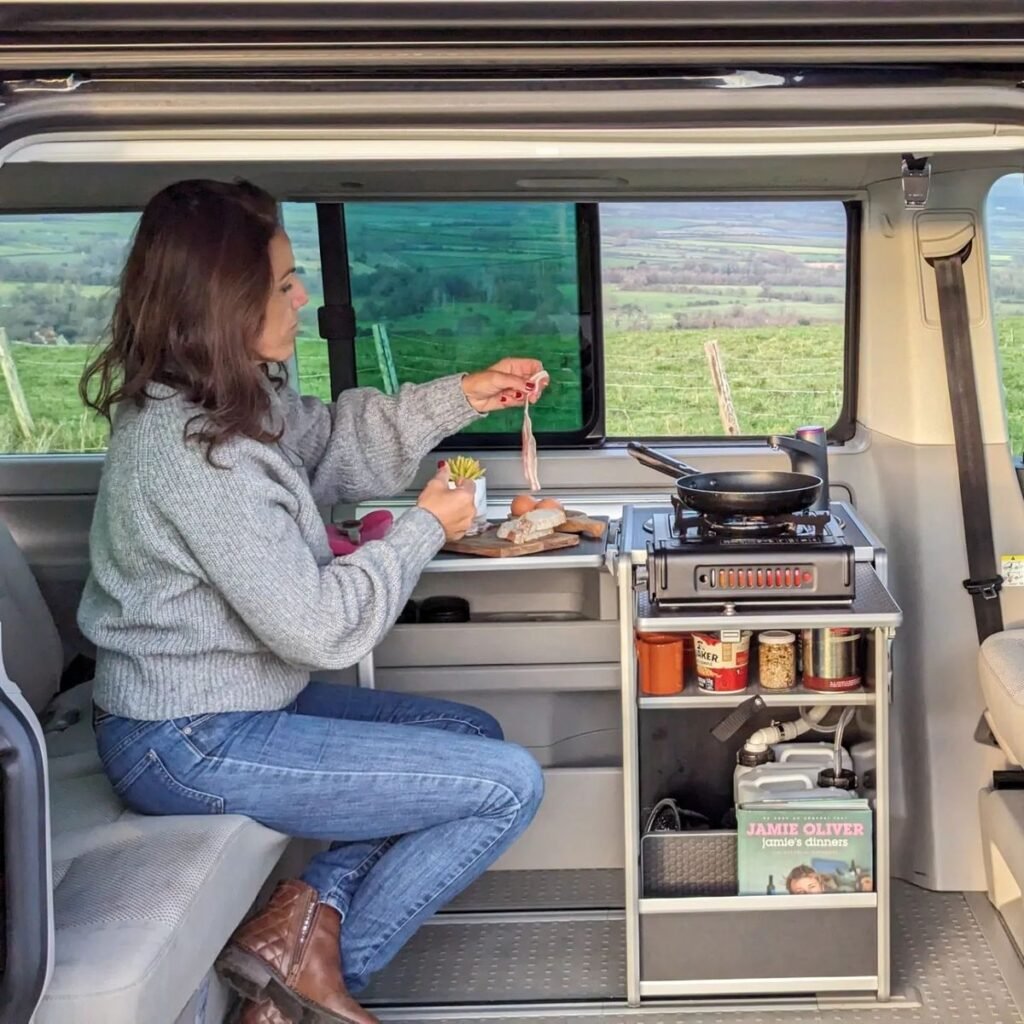
The pan comes down every morning. Eggs are almost always the first task, usually around seven when I’m parked with a view and want breakfast before the light changes. Carbon steel does eggs better than any non-stick surface I’ve cooked on once the seasoning is established. The fat moves in the pan, the white sets without sticking, and if I want crispy edges I tip the pan slightly and baste with the oil for thirty seconds. That’s not a technique that works on a scratched, worn surface trying its best.
Lunch tends to be fast. Tinned chickpeas with garlic and paprika, chorizo rounds with leftover roasted peppers, whatever assembly makes sense from what’s there. The kind of quick low-effort cooking that the van life breakfast rotation piece and similar quick-cook ideas are built around. The pan handles all of this at medium heat in under ten minutes and cleans up in under two. It’s not asking anything complicated.
Dinner is the proper cook of the day. A piece of fish, a steak when I’m near a good market, shakshuka when I want something filling from pantry staples. The pan’s ability to hold a consistent temperature without developing hot spots is what makes these meals work on a single-burner gas setup, where you don’t have the luxury of spreading heat across a large cooker. And for the high-protein no-cooler meals I rely on during longer off-grid stretches, the reliable high-heat sear on tinned fish and shelf-stable proteins makes a real difference in what the finished dish actually tastes like.
Sixteen months. Same pan. Every day without exception.
The hook on the cabinet side holds it at exactly the right height. First thing reached for in the morning, last thing oiled and hung up at night. That’s the test that matters for gear in a van kitchen, which is exactly the standard Van Life Kitchen tries to hold gear recommendations to. Not what something theoretically can do, what it actually does every day.
FAQs
Is the De Buyer Mineral B specifically worth it, or are there alternatives that do the same job?
The Mineral B is a genuinely good pan and the price is reasonable in the 24cm or 26cm sizes. But it’s not uniquely indispensable. The Lodge carbon steel skillet is a solid alternative, particularly in North America where it’s easier to find and somewhat cheaper. The Matfer Bourgeat is another option used professionally in restaurant kitchens. The specs that matter in any carbon steel pan: a gauge of at least 2.5mm for heat distribution, a riveted rather than welded handle, and a rolled lip for pouring. Any pan hitting those three criteria will perform comparably for van cooking purposes. Avoid the very thin versions under 2mm; they develop hot spots on uneven gas flames and warp with sustained high heat.
How long before the surface is actually non-stick enough to cook eggs cleanly?
The initial three-layer seasoning gets the pan usable from day one, but eggs without sticking typically arrives somewhere around month two, sometimes earlier if you’re cooking fatty foods regularly. Bacon, chicken thighs, and sausages contribute more per cook to the seasoning than vegetables or eggs, so the surface builds faster if those are part of your rotation. By month three of daily use, most people find the pan noticeably easier to manage than when they started. By month six, it’s a genuinely different surface from the one you first seasoned.
Does it work well on a single-burner butane setup, given the smaller burner ring?
Better than cast iron does, as it happens. Carbon steel heats faster on lower BTU burners because the walls are thinner and the overall mass is lower. The approach that works well: bring the pan up on medium rather than high, give it sixty seconds to reach temperature before adding fat or food, and cook in slightly smaller batches than you might in a larger kitchen. The last part is just good van cooking practice anyway and applies to every pan. Nothing specific to carbon steel.
What’s the actual rust risk for full-time van life, especially in wet climates?
Real, but completely manageable with the drying habit in place. In a humid coastal environment without consistent drying, surface rust can appear within a few days of a damp pan being stored. In a dry inland climate with the habit established, it’s essentially never an issue. If it does happen: coarse salt and neutral oil paste, scrub off the rust, dry on the hob, re-season with one or two thin oil layers. Five minutes and the pan is back to where it was. It’s a surface issue, not structural damage. Building the drying habit in week one makes this a non-question.
How do you store it without damaging the seasoning when space is tight?
Hang it if at all possible. A single hook on a cabinet side means the cooking surface never contacts anything else, which is both the simplest and the safest storage solution. If you need to stack it, put a folded cloth between the cooking surface and whatever sits against it, and never store anything wet underneath or on top. The seasoning isn’t delicate once it’s built up to depth; it just dislikes sustained contact with moisture and abrasive surfaces. Most van setups that mount the pan on a hook have no storage problems. That’s where mine has lived since about week three, and it hasn’t moved since.
The pan goes up on the hook every evening, after the oil wipe, while the warmth is still in it. In the morning it comes down again.
That’s the whole case for it.