
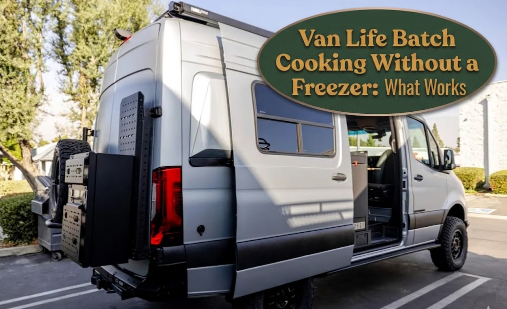
The first time I tried to batch cook in the van, I spent a solid Sunday afternoon making five full dinners in one session. Chicken pasta, a dahl, a stew, an assembled grain salad, and a soup. Very proud of myself. Stacked the containers, wedged them into the fridge, done. Day one, great. Day two, still fine. By day three, the chicken pasta had gone a bit grey and the assembled salad was a soggy, wilted mess. Two containers went straight in the bin.
And that was that. First proper attempt at meal prep on wheels: two out of five.
The problem wasn’t the cooking. The problem was that I was treating the van like a domestic kitchen with a big freezer sitting in the garage behind it, just squeezed into a smaller space. Without a freezer to lock meals in, the whole approach needs rethinking. Most of the batch cooking advice you’ll find online is written for people with full-size refrigerators and a chest freezer to fall back on. The van version is a different exercise entirely.
So this is what I’ve actually found works — and what keeps failing no matter how well-intentioned it is.
1. The Fundamental Shift: Ingredients, Not Meals
Stop trying to cook complete meals in advance. Cook components instead.
A pot of cooked lentils is not a meal on its own. But pair it with some roasted veg and a spoon of harissa and it becomes one. The next day, the same lentils go into a quick soup with stock and a handful of spinach. The day after that, they fold into a wrap alongside some leftover couscous and a fried egg. One 30-minute cook has just stretched across three meals with no waste and no flavour repetition.
Compare that to making a full lentil dahl on day one, eating it that evening, then eating the same dahl again on day two and day three until the smell of cumin makes you faintly hostile.
The ingredient approach also gives you something genuinely valuable on the road: flexibility. When you pull into a village market in southern France and there are beautiful aubergines going for almost nothing, you can grab them and fold them into whatever component base you’ve already got. You’re not locked into a fixed plan that requires specific ingredients at a specific time.
This is exactly the thinking behind a lot of the recipes over on Van Life Kitchen’s recipes cooked on repeat — flexible building blocks that work across multiple meals without turning cooking into a rigid routine.
2. What Actually Holds Up Without a Freezer
Not all cooked food is equal when it lives in a 40-litre 12V compressor fridge with no freezer compartment. Some things keep beautifully for four or five days. Others become a food safety question by day three.
Here’s what I’ve found through actual use, not theory:
| Food | Fridge Life | Notes |
|---|---|---|
| Cooked lentils or chickpeas | 4–5 days | Cool completely first; store in a sealed container |
| Cooked brown rice or quinoa | 4–5 days | Don’t leave at room temperature for more than an hour |
| Roasted root vegetables | 4–5 days | Harder veg (sweet potato, carrot) last best |
| Soups and stews | 3–4 days | Often better on day two once flavours settle |
| Cooked pasta | 2 days | Gets stodgy fast; better to cook fresh and batch the sauce |
| Hard-boiled eggs (unpeeled) | 5–7 days | Don’t peel until you need them |
| Homemade pesto or herb sauces | 5–7 days | Cover with a thin layer of olive oil to seal |
| Cooked chicken | 2–3 days max | Consume quickly or don’t batch it at all |
| Cooked fish | 1–2 days max | Not worth batching; cook fresh every time |
One thing this table can’t capture is what happens when your van has been parked in full sun on a 30-degree day somewhere in Portugal. A fridge that normally runs at a steady 4°C can creep up, especially if the van hasn’t been ventilated and you’ve been opening the door a dozen times. I’d knock at least a day off everything in those conditions. A basic fridge thermometer tells you what’s actually happening versus what you’re hoping is happening — it’s one of those small tools with a disproportionate impact on how confidently you can cook. The Van Life Kitchen gear guide covers some of these essentials if you’re still building out your kitchen setup.
3. The Propane Argument Nobody Makes Loudly Enough
There’s a practical case for batch cooking in a van that goes beyond meal planning, and it’s the one that really convinced me to commit to it.
Gas.
Every time you fire up the burner for a separate meal from scratch, you’re burning propane. When you batch cook components, you do one longer cook every three or four days rather than six separate ones. Over a week on a standard canister, the difference is real — particularly during stretches where resupplying gas isn’t convenient or cheap.
A big batch of grains or a pot of soup uses roughly the same fuel as one quick stir fry. But that batch feeds you four times. The maths on that is pretty straightforward, and on the road it matters.
4. Where People Consistently Go Wrong
I’ve made most of these mistakes myself, and they come up constantly in van life cooking conversations.
Batching meat too enthusiastically. Cooked chicken keeps for two to three days in a properly cold fridge. People assume that because they bought it fresh and cooked it the same day, the clock doesn’t move quickly. It does. Fish is even less forgiving — a day, maybe two at the absolute outside. If your batch cooking strategy relies heavily on cooked meat and fish as the protein anchor, you’ll end up either eating too fast or throwing too much away. The fix is leaning into plant-based components for the batch prep. Lentils, chickpeas, roasted veg, grains — they hold up better, cost less, and don’t cause the same low-level anxiety about whether something is still safe to eat.
Putting hot food straight into the fridge. A steaming container dropped into a small 12V fridge makes the compressor work hard to compensate, drains the battery faster, and warms up everything else already in there. Let things cool on the counter for 20 to 30 minutes first. That’s one extra step, but it protects both food quality and power budget, and in a van those things are connected.
Storing everything in one big container. Opening a giant container of batch-cooked lentils every time you want a portion lets warm air in and shortens the life of the rest. Portion before it goes in the fridge. Smaller sealed containers, opened once. It sounds fussy but it makes a genuine difference over a four-day stretch.
And this one is harder to put in a list: ignoring smell as a signal. A small van fridge builds up smells quickly and when something is borderline you’ll know before you see it. Trust that instinct. A stomach bug when you’re parked somewhere remote is a very different problem than one at home.
5. A Simple 4-Day Batch Cook Rotation That Actually Works
What I’ve settled into is a rotation that requires one proper cook session every four days, a few minutes of reheating on subsequent days, and very little mental effort once you have the rhythm.
The session looks like this.
Start a large batch of grains — usually brown rice or pearl couscous. 25 minutes with the lid on and minimal attention needed.
While that’s going, roast whatever vegetables are available. Mixed root veg, cherry tomatoes, courgette, whatever’s in the box. Oil, salt, and either 30 minutes covered in a pan on a medium flame, or in the Omnia stovetop oven if that’s part of your setup.
Make a flavour base. This is the bit that changes the character of the meal every day without requiring you to cook anything new. Day one: harissa stirred through with some yoghurt. Day two: a quick tomato and garlic sauce from a tin of chopped tomatoes. Day three: tahini loosened with lemon juice and a little water. The underlying components stay the same. The flavour wrapper changes.
Add a pot of soup or stew if you want something more substantial for a couple of lunches.
The whole session takes 60 to 75 minutes, uses one burner efficiently, and covers four days without needing to think much. For a fuller version of how to structure these into a weekly plan, Van Life Kitchen has a 7-day van meal planning guide that builds on this kind of approach.
A Quick Note on the Mental Side of This
This section isn’t really part of the main structure — more of an aside.
Cooking from scratch every single night in a van is genuinely tiring after a while. After a long driving day, finding a spot, setting up, dealing with whatever the road threw at you — standing at a small stove to build a whole meal from nothing isn’t always what you want. Batch cooking gives you an exit ramp on those nights. Reheating five minutes’ worth of lentils and roasted veg is still a proper meal. It’s not giving up on good food, it’s just having the good food already done.
And the days I’ve been most grateful for it were the ones where something went sideways — a flat tyre, a campsite that turned out to be a car park, arriving late in the dark somewhere unfamiliar. On those nights, the container sitting in the fridge is the thing standing between me and a service station sandwich.
FAQs
Can I batch cook in a van without any fridge at all?
You can cook and eat the same day without a fridge, but a multi-day batch rotation won’t work safely. Cooked legumes and grains at room temperature are only safe for about two hours before bacteria multiply to concerning levels. Without refrigeration, you’re really cooking for that meal and maybe the next, not a four-day plan. Some shelf-stable options — tinned chickpeas, vacuum-sealed cooked grains from supermarkets — can fill the gap if you’re fridge-free.
How do I stop batch-cooked rice from going dry and hard in the fridge?
A splash of water or stock when reheating does most of the work. Cover it during reheating so the steam softens it back. Some people also add a small piece of damp kitchen paper under the container lid before sealing it for the fridge — it retains a bit more moisture. It won’t be identical to freshly cooked, but it’s close enough.
Is a 12V compressor fridge really sufficient for this, or do I need a freezer drawer?
A good 12V compressor fridge — anything from the Dometic, Waeco, or similar reliable ranges — is entirely sufficient if you keep an eye on temperatures. The target is 3 to 4°C. Older thermoelectric cool boxes struggle to reach that in warm weather and I wouldn’t trust one for anything beyond a day or so. A freezer drawer adds flexibility for things like bread and meat, but it’s not essential for the component-based approach described above.
What containers work best for batch cooking in a van?
Square glass containers stack better than round ones in a small fridge and don’t stain or absorb smells from strong ingredients like harissa or tomato sauce. The trade-off is weight and the obvious breakage risk. If weight matters to you, decent BPA-free plastic with properly locking lids is the practical middle ground. Whatever you use, check that the seal actually clicks shut. A loose lid is a fridge-smell disaster that contaminates everything around it and the problem compounds fast in a small space.
Does batch cooking for one person in a van even make sense?
It actually works better for solo travellers in some ways, because the quantities stay manageable. A batch designed for four meals for two people is a lot of food to get through before anything turns. For one person, halve the quantities, and build in one fresh-cook meal per cycle just to break the pattern and remind yourself that you actually enjoy cooking, not just reheating.
The bottom line is that batch cooking without a freezer is very doable — it just works differently from how most of us learned to do it. Component thinking, a clear-eyed understanding of what keeps and for how long, and one fridge thermometer. That’s genuinely most of what it takes. Get those three things right, and the day-to-day cooking side of van life becomes noticeably easier.