
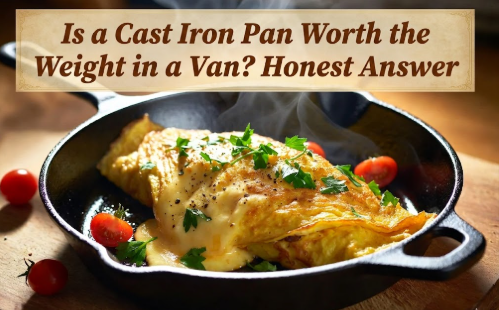
A standard 10-inch cast iron skillet weighs 2.4kg. My full cooking kit, including the hob, two pans, a lid, and a spatula, comes to just over 4kg. For a long time I refused to do that maths, because the answer was uncomfortable and I liked having the cast iron.
Eventually the van I was building forced the question. Smaller footprint, less storage, every item earning its place. And I had to be honest about what the cast iron was actually doing versus what I wanted it to do.
1. Why This Isn’t Just a Question About the Pan
The cast iron debate comes up constantly in van cooking conversations, and most responses land in one of two camps. There’s the enthusiast take: commit to it, the cooking result justifies the weight, anything else is a compromise. And there’s the minimalist take: too heavy, buy a carbon steel and move on. Both positions are too clean.
The honest answer depends entirely on how your van is set up, how often you move, and what you’re actually cooking day to day. Someone in a high-roof Sprinter with a fixed kitchen build and a wall-mounted pan rail is working with a different equation than someone in a medium-wheelbase Transit where everything comes out of a storage drawer twice a day.
I’ve been in both setups. The answer isn’t the same in both.
What I mean is, this isn’t about whether cast iron is a good pan. It clearly is. The question is whether the specific conditions of van life make it worth carrying.
2. The Weight Numbers You Should Know Before Deciding
A Lodge 10-inch cast iron skillet: 2.4kg. A de Buyer Mineral B carbon steel at the same size: around 1.0kg. A mid-range 24cm ceramic nonstick: 0.6 to 0.8kg.
The cast iron weighs roughly two and a half times what a carbon steel does and three times what a decent nonstick does. Over a cooking kit you’re picking up, stowing, and repositioning daily, that difference shows up.
There’s also the heat retention side, which cuts both ways. Cast iron stays hot for a long time after cooking, which is useful for resting food, but also means it can’t go away quickly after a meal. In a Sprinter with a proper fixed kitchen, not a problem. In a smaller van where you need to pack down within 20 minutes and get moving, a still-warm 2.4kg skillet that can’t be safely put away yet is a recurring inconvenience.
And rust is a more serious issue in van environments than most cast iron guides admit. Temperature swings through the night, condensation from cooking, limited ventilation, coastal air, all of these create conditions where bare iron rusts faster than in a house kitchen. I had visible rust spots appear in under a week on the coast once, after getting sloppy with the drying routine for just two nights in a row.
| Pan Type | Approx. Weight (10-inch) | Preheat Time on Gas | Maintenance | Works on Induction |
|---|---|---|---|---|
| Cast Iron | ~2.4kg | 4–5 minutes | High: dry and oil after every use | Yes |
| Carbon Steel | ~0.9–1.0kg | 2–3 minutes | Moderate: some seasoning builds over time | Yes |
| Ceramic Nonstick | ~0.7kg | 1–2 minutes | Low: no metal tools, avoid high heat | Most brands: yes |
| Stainless Steel | ~0.9kg | 2–3 minutes | Low: wipe clean, no special care | Yes |
The preheat column is worth looking at seriously. Four to five minutes of gas to bring a cast iron up to temperature before food even goes in is real fuel consumption. For a long dinner, fine, it’s absorbed into the total cook time. For reheating yesterday’s rice or making two eggs, it costs more fuel than the actual cooking.
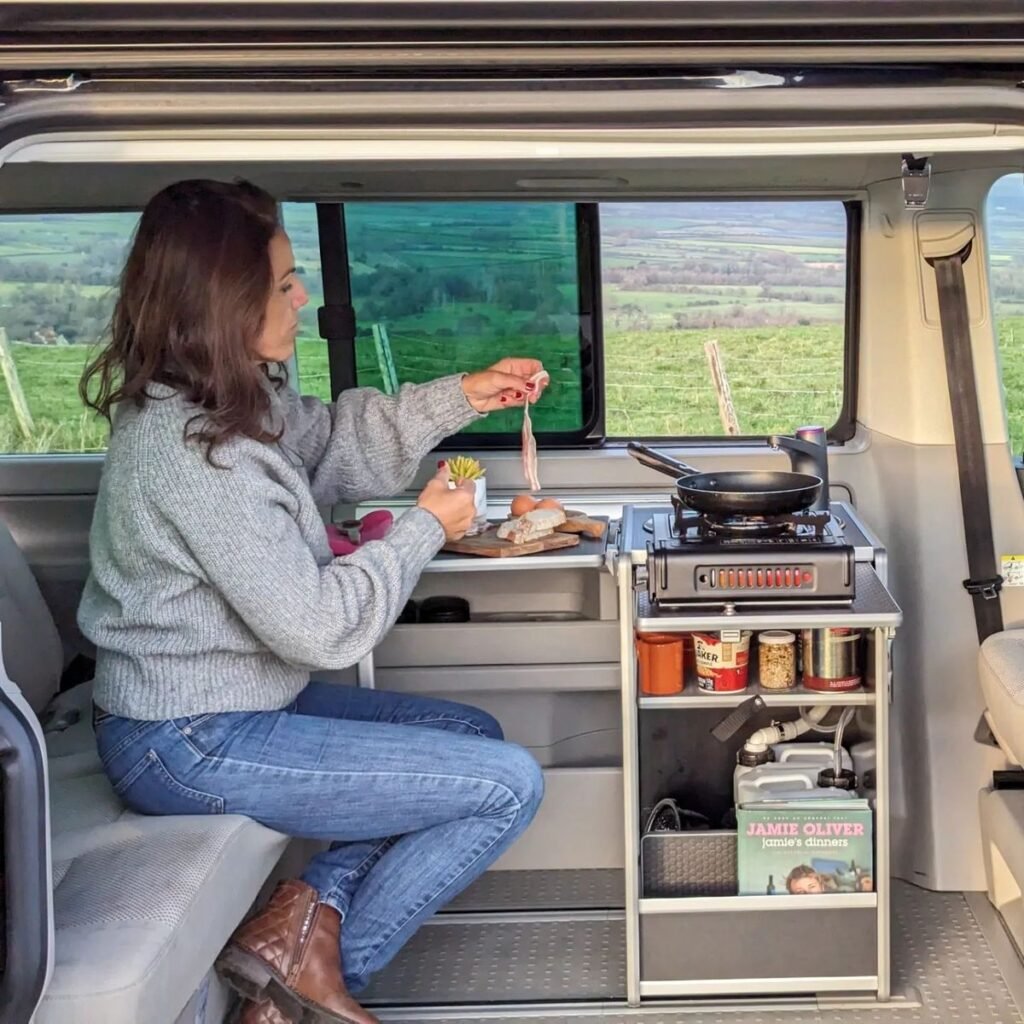
3. What Cast Iron Gets Right in a Van
The thermal mass is the real story, and it’s not a small difference.
When cold food lands in a lightweight pan, the surface temperature drops. The pan recovers, but there’s a gap where the food steams rather than sears, and the Maillard reaction stalls. In a cast iron, that temperature drop is slower and shallower. The contact stays hot. You get a proper crust on chicken thighs, a real sear on a piece of steak, proper browning on onions rather than a soft, slightly grey result.
For skin-on proteins specifically, there’s no lightweight equivalent that replicates this. I’ve tested it properly. A chicken thigh skin-side down in a carbon steel gets close, a nonstick doesn’t even approach it.
Flatbreads and corn tortillas are the other thing. A dry cast iron skillet, fully preheated, on a corn tortilla for 30 seconds each side gives you charred spots and blistering that only happen with sustained surface heat. The same tortilla in a nonstick comes out pale and soft. This is the detail that separates van tacos from ordinary ones, and if you’re cooking the kind of meals covered in the van taco guide on Van Life Kitchen, the pan is genuinely part of the result.
Cast iron handles campfire and open flame without any concern too. Carbon steel also does this, but nonstick is out entirely over open flame, and coated pans don’t survive the heat irregularity of a fire. If your van life includes cooking on a fire pit or a wood grate, cast iron, cast iron doesn’t care. It just keeps working.
And there’s the longevity argument, which is real. A Lodge pan bought now will still be cooking properly in 30 years. The seasoning gets better with use rather than degrading. It doesn’t chip, it doesn’t strip. The surface keeps improving with the right use. When you’re replacing a nonstick every two years because the coating has gone, the lifetime maths on cast iron starts looking different.
4. Where Cast Iron Creates Actual Problems
Eggs. And the egg situation isn’t mythologized.
Until the seasoning is fully developed, which takes months of consistent cooking, not weeks, eggs will stick in a cast iron pan. Not just a little. I’ve had scrambled eggs fused to a pan I thought was well-seasoned because I didn’t wait long enough for the preheat or the heat was slightly too high. Cleaning stuck egg off cast iron with limited water is a scrubbing session you don’t want. And if you use soap to get it clean, you’ve damaged the seasoning and you’re starting the build-up process again.
If breakfast is central to your van routine, and for most van cooks it is, the van life breakfasts guide covers options that work on a pan without a fully mature seasoning. Cast iron eggs get there eventually. Just not in the first few months.
Acidic cooking is a bigger issue than most reviews acknowledge, and it matters particularly in van kitchens because a lot of van cooking involves canned tomatoes. A pasta sauce, a quick chickpea stew, a tomato-based one-pot — all of these react slowly with bare cast iron. The seasoning strips, the food can pick up a faint metallic note, and you’re back to re-seasoning before the pan works properly again. A lot of the component cooking covered in Van Life Kitchen’s batch cooking guide is built around exactly this kind of tomato-heavy base cooking, and cast iron isn’t the right tool for that work.
The maintenance routine also becomes a more consequential thing in a van. The requirement is simple: dry the pan on a low flame for 30 seconds after washing, wipe a thin layer of neutral oil across the surface, put it away dry. Under a minute. Non-negotiable. You can skip this with stainless or carbon steel and the consequences are minor. With cast iron in a van environment, the nights you’re most tempted to skip it, the late arrivals, the long drives, the days when you’re running on empty, those are exactly the nights rust forms fastest. I’ve learned that the hard way more than once.
Gas efficiency is the other thing worth taking seriously. Four to five minutes of preheat before anything cooks is a cost that accumulates. Over a week of cooking two or three meals a day, cast iron uses meaningfully more gas than a lightweight pan for the same output. On a long trip between resupply points, that adds up.
5. Who Should Actually Use One
After testing this across enough different setups, the split is reasonably clear.
Cast iron makes sense for van cooks who:
- Cook seared proteins regularly and want actual crust on chicken thighs, steak, or skin-on fish
- Make flatbreads, corn tortillas, or any high-heat dry-contact cooking at least a few times a week
- Are mostly stationary, parked in one location for multiple days at a stretch
- Have a fixed kitchen build with a wall mount or hook so the pan lives in one consistent spot
- Cook for two or more, where the thermal mass justifies itself over larger portions
- Are committed to the dry-and-oil routine after every single use, not just when they remember
Cast iron is probably wrong for van cooks who:
- Cook primarily eggs, acidic tomato-based meals, or delicate fish
- Are solo and cooking small portions where the preheat overhead doesn’t pay off
- Cover a lot of ground daily and move their cooking kit in and out of the van every time they stop
- Are watching their fuel budget carefully and 4 to 5 minutes of extra preheat time is a real cost
- Won’t reliably maintain the pan when they’re tired or the tap is far away
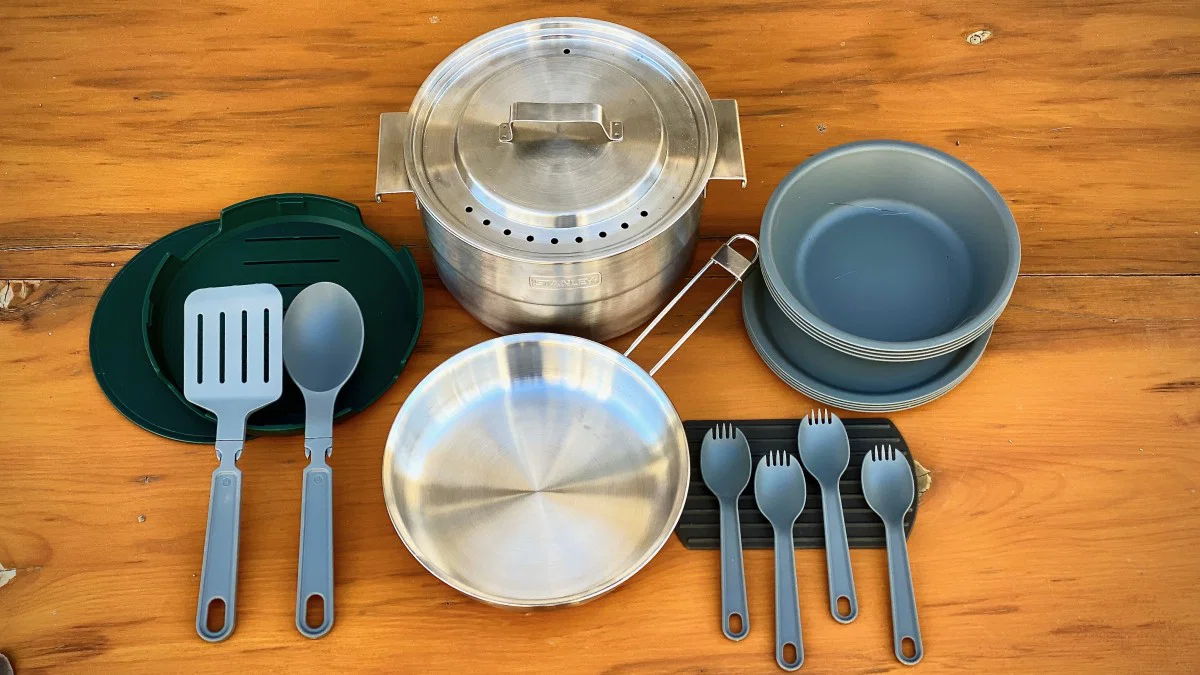
The setup I’ve landed on after years of actually testing this is a 10-inch carbon steel for daily cooking, eggs, sauces, stir-fries, anything quick, and a small Lodge 6.5-inch cast iron kept specifically for flatbreads, tortillas, and the occasional high-heat sear when a proper crust matters. The 6.5-inch cast iron weighs around 1.3kg. Both pans together: under 2.4kg. The same weight as a single 10-inch cast iron, but with far more flexibility and fewer daily compromises.
Two specific tools doing specific jobs beats one pan trying to do everything. That thinking applies across most van kitchen gear decisions. Once you’re clear on what you’re actually going to cook on the road, the pan question gets easier. The no-fridge van recipes archive gives a decent sense of the meal range that’s realistic for most van cooks week to week, and whether cast iron fits into that naturally or sits awkwardly on the edge of it.
FAQs
Can you use a cast iron pan on a van induction hob?
Yes, cast iron is fully induction compatible. The material is magnetic and the flat base makes good contact with the hob surface. The practical consideration is preheat time, which is longer on induction than gas, and the energy draw during that preheat is higher than with a lighter pan. If your van runs on a small inverter or a tight lithium battery bank, carbon steel preheats faster and draws less power for the same cooking result.
How do you prevent rust on a cast iron pan in a van?
The routine is simple: dry it on a low flame for 30 seconds after washing, wipe a thin coat of neutral oil across the surface, then store it somewhere away from moisture. That’s it. What doesn’t work is putting the pan away slightly damp, or skipping the oil step when you’re tired. In a van environment, especially coastal or high-humidity conditions, rust can form in under a week from just two or three careless nights. Once the habit is built it takes under a minute per session, but it has to be consistent.
What size cast iron is most practical for van cooking?
For solo cooking, the Lodge 6.5-inch (or an equivalent small skillet) is the most useful size. It handles two eggs if your seasoning is mature, one chicken thigh, tortillas, and small sears without carrying the full weight of a 10-inch. For cooking for two, the 10-inch is the better choice and the size where the thermal mass really starts to justify itself. Anything larger than 10 inches is hard to justify in most van kitchens on weight, storage, and actual use frequency.
Is carbon steel always the better choice over cast iron for van life?
For most van cooks, carbon steel is the better daily pan. Lighter, faster to preheat, similar seasoning behaviour over time, and fewer cooking limitations. The areas where cast iron stays ahead are maximum thermal retention for high-heat searing and flatbread cooking where sustained dry contact heat produces a specific result. If you’re not doing those things regularly, carbon steel covers everything without the weight, the rust risk, or the maintenance commitment.
Can you season cast iron without an oven in a van?
Yes. Wipe a very thin layer of high-smoke-point oil across the surface, then remove almost all of it so the pan looks barely coated. Heat over medium-high until the surface smokes lightly, then let it cool completely. Two or three rounds of this builds a working base seasoning. It won’t be as even as a full oven cycle, but it functions well enough to cook with. Realistically, the most effective way to build seasoning on the road is just cooking fatty things consistently, bacon, chicken skin, anything oily. That builds it gradually without any dedicated session and without needing an oven at all.
Van Life Kitchen covers practical cooking decisions, real gear assessments, and recipes built for life on the road. The one-pot meals archive is a good starting point if you’re thinking through what cookware you actually need for the cooking you actually do.