
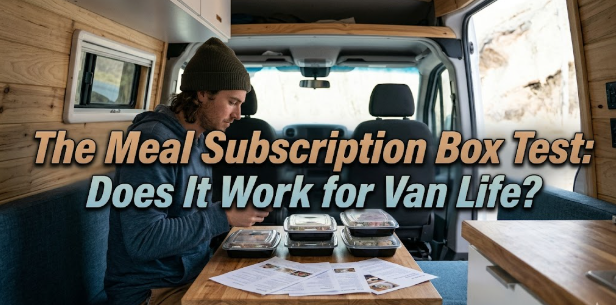
The result surprised me more than I expected it to.
Not in a good way necessarily, but not entirely in a bad way either. That’s the honest summary before we get into any of it.
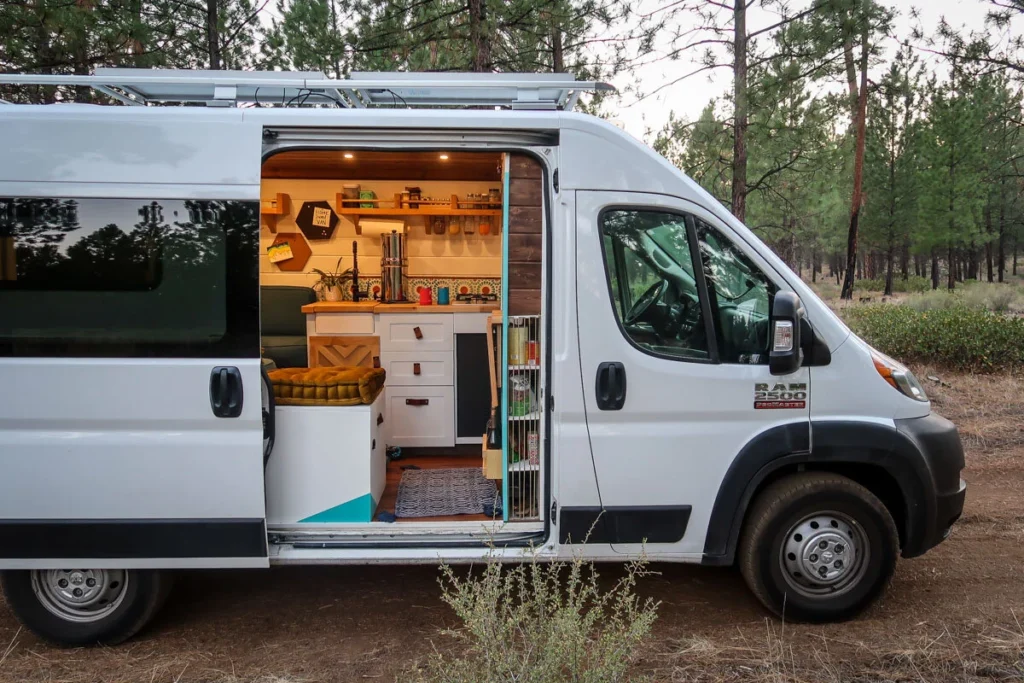
I’d gone into this assuming meal subscription boxes would be completely useless for van life. Moving vehicle, no fixed address, a cooler that runs off a battery I’m constantly managing. The whole concept seemed built for people with kitchens, schedules, and front porches. Not for someone parked at a BLM site outside of Sisters, Oregon trying to figure out dinner before the sun goes down.
So I tested it. Properly. Three different services over six weeks: HelloFresh, EveryPlate, and Green Chef. Roughly 14 meal kits total, cooked on a two-burner Coleman camp stove, in campgrounds, a few parking lots, and once in the rain outside a Walmart with a tarp propped up on hiking poles because I’d committed to making that shrimp and I wasn’t going to let the weather win.
Here’s what actually happened.
1. Getting Them Delivered: Harder Than It Should Be, Easier Than I Thought
The first question everyone asks: how do you get a meal kit delivered when you don’t have a fixed address?
Honestly, this was easier to solve than I’d assumed. Most subscription services let you change your delivery address week to week. So I set up deliveries to a friend’s place in Portland for the first two weeks, then to a family member’s address in Bend for the third week, and so on as my route moved south. If you have people in places you’re already planning to pass through, the logistics aren’t that bad.
The trickier part was timing. The kits arrive chilled, packed in insulated foam boxes with ice gel packs. Those packs stay cold for roughly 48 hours if the box sits somewhere shaded. If it’s sitting on a porch in afternoon summer sun, that window narrows fast.
I missed one delivery window by a day. Showed up to my friend’s house a day late because of some unexpected road delays through the Cascades, and the proteins had to go straight in the trash. The produce was fine, the sauces were fine, but I wasn’t willing to gamble on the fish. That’s not a van life problem specifically, that’s just cold chain reality. But when your schedule is unpredictable by nature, that risk is bigger than it sounds.
If you’re moving through areas with reliable contacts and a reasonably predictable timeline, this part is workable. If your route is genuinely unplanned or you regularly run behind your own schedule, the logistics will start to frustrate you inside of a month.
2. The Cooler Situation Nobody Mentions on the Box
Meal kit ingredients assume refrigeration. Consistent, reliable refrigeration at or below 40 degrees Fahrenheit.
My 12-volt cooler holds temp well when it’s running off the battery system and I’m driving regularly. On days when I’m parked and conserving power, it drifts warmer. That’s just reality. Some of the kits I was working with had proteins that I wasn’t comfortable holding for more than two days under those variable conditions.
What survived marginal cold storage without incident: hard cheeses, sealed sauce packets, root vegetables, garlic, shallots, citrus, most of the vacuum-sealed grains, and dried spice blends. Things that needed to be used immediately or were headed for the trash: raw seafood (every single time), pre-marinated chicken that had been sitting for more than 36 hours, fresh herbs, and the little cream containers that show up in some Green Chef kits.
I’ve written about ingredient sequencing over at Van Life Kitchen before, and the principle that works for batch cooking applies here too: you cook proteins first, you eat them fast, and you don’t wait to see how things go. The problem with meal kits is the recipes are designed to use everything together, on the same evening. They’re not built for the “cook the chicken tonight, use the vegetables over the next two days” logic that keeps van cooking functional.
If you want a deeper look at how I sequence ingredients without a proper freezer, this piece on van life batch cooking covers the actual decision tree I use. Meal kits don’t fit neatly into that framework, and that’s part of the problem.
3. What the Cooking Actually Looks Like in Practice
This is where it got genuinely interesting.
Some of the recipes were straightforward. Simple, one-pan weeknight stuff that I could adapt without much trouble. A lemon herb chicken with roasted vegetables that worked fine on the camp stove with the lid on the cast iron to trap heat. A garlic butter shrimp that I finished in the pan instead of under a broiler. A chickpea and tomato stew from a Green Chef kit that was honestly one of the better meals I ate on the whole trip, and I’ve since recreated it from scratch at least four times.
But a lot of these kits assume a full kitchen. Oven at 400 degrees. Two burners running simultaneously. A colander for draining pasta. A sheet pan. None of that exists in my setup.
Cooking for one on the road already requires its own set of adjustments, and if you’re thinking through portion realities and what actually makes sense to prep solo, this one on van life meal prep for solo travelers gets into the specifics. Meal kits do solve the portion problem elegantly, since everything comes pre-measured, and that part I actually appreciated. No guessing, no waste. But the cooking method assumptions made up for that convenience and then some.
EveryPlate had the simplest recipes and translated best to van cooking. Nothing too ambitious. HelloFresh had more variety and generally better ingredient quality, but they lean heavier on oven use than I expected. Green Chef, which positions itself around dietary preferences, had some solid no-oven meals but also oddly fussy prep steps for a small space. Lots of “julienne the radish, mince finely, fold in gently” language that assumes you have a cutting board bigger than a paperback book.
My cutting board is the size of a paperback book.
4. What Works and What Doesn’t: An Honest Breakdown
Here’s where most people in van life forums get this wrong. They treat the question of meal kits as binary. Either “totally impractical” or “yes, works great.” Both answers are too simple.
The real answer depends entirely on what your next two weeks look like.
| What Works | What Doesn’t |
|---|---|
| Pre-portioned ingredients reduce waste | Cold chain depends on reliable delivery timing |
| No menu planning required for the week | Most recipes assume oven plus multiple burners |
| Forces genuine variety into your rotation | Packaging is bulky and generates real waste |
| Quality is usually better than convenience store food | Delivery address requires contacts along your route |
| Great during stationary stretches (friends’ places, etc.) | Proteins are risky under marginal cold storage |
| Introduces recipes you can recreate from scratch later | Instructions assume counter space you probably don’t have |
If you’re spending a week parked at a friend’s house. If you’re in a stretch of the trip that’s more stationary than mobile. If you’ve got a solid fridge running reliably. Under those conditions, a meal kit box can actually be a good week. The ingredients are fresh, the variety is real, and the learning curve is low if you’re willing to adapt the method.
As a regular system for someone moving every two or three days on a loose schedule? It creates more stress than it solves.
What I didn’t expect was the recipe value. That chickpea stew from Green Chef. A garlic noodle situation from a HelloFresh box that I’ve now made six times from my own pantry. For those alone, the experiment was worth doing. I have a small library of dishes now that I learned through the kits and can cook without them.
Compared to building meals from stable pantry staples, these boxes are pricier and less flexible. If you’ve never looked at no-fridge van recipes built around pantry staples, that approach is almost always more practical for daily life on the road. But practical and interesting aren’t always the same thing, and sometimes you want fresh salmon, a real sauce, and something that isn’t rice and lentils.

5. The Packaging Problem, and the Mistake People Keep Making
I want to flag something that doesn’t come up enough in these conversations: the packaging.
Every kit arrives in an insulated foam box, with multiple plastic-wrapped ingredient packets and ice gel packs inside. It’s a lot of material for a week of meals. On the road, you’re not always near decent recycling facilities, and a foam cooler box doesn’t fold flat into your trash bag.
I started pulling all the ingredients out immediately on receipt, consolidating them into my own reusable containers, and dealing with the packaging at the first available point. The ice gel packs I actually kept and used as supplemental cooling in the cooler, which helped. But the plastic individual bags, the ones that each spice and sauce come in, those add up and there’s not much you can do with them.
I’m not going to moralize about it. It’s just a practical reality worth factoring into the decision.
The bigger mistake I see van lifers make with meal kits is using them as a solution to the “I don’t know what to cook” problem. That’s a planning problem, and it has cheaper, simpler solutions. What meal kits actually solve, when conditions are right, is the “I want something genuinely fresh and different and I have the setup to make it happen” problem.
Those are different problems. Knowing which one you actually have matters quite a bit.
On the nights when I just want something solid without any of this deliberation, one-pan van dinners is what I return to. No timing issues, no delivery addresses, no wondering whether the chicken is still okay.
The subscription box experiment was worth doing. I don’t regret it. But I haven’t re-subscribed.
FAQs
Can you actually get a meal kit delivered when you live in a van? Yes, if you have some flexibility in your route and contacts along the way. Most subscription services allow you to change your delivery address each week, so as long as you have a physical address to send it to, friends, family, or even a campground that accepts packages, it’s workable. The constraint is that you need to be there within roughly 48 hours of arrival, which gets harder the more unpredictable your schedule is.
How long do meal kit ingredients last in a van cooler? Proteins are the biggest risk. Raw seafood I’d use within 24 hours, full stop. Chicken in consistently cold storage, 48 hours at the outside. Vegetables and sealed sauces last much longer, often three to four days even in less-than-ideal conditions. If your cooler temperature varies, prioritize cooking proteins on the first night and build the rest of the meals around what remains.
Which service works best for van life cooking? Based on what I tested, EveryPlate had the simplest recipes with the least equipment required, which makes it the easiest to adapt. HelloFresh has better ingredient quality and more variety but leans toward oven use more often than I’d like. Green Chef is the priciest, and some of the prep steps are genuinely fussy for a small kitchen setup. I’d start with EveryPlate or HelloFresh’s simpler options and skip anything labeled “chef-crafted” or “restaurant-inspired” in the kit descriptions.
Are meal kits actually worth the cost for van life? Not compared to building meals from pantry staples, no. Per serving, kits run roughly $8 to $14 depending on the service and plan. That’s significantly more than what you’d spend buying ingredients loose, and it’s not as economical as the batch cooking strategies I’d normally recommend. The value, when there is value, is in fresh ingredients and variety you wouldn’t otherwise have access to on a remote stretch of road. Cost efficiency is not where these services compete.
What do you do with all the packaging waste? It builds up faster than you’d expect. The foam insulated boxes can be broken down flat but take up real space until you can dispose of them. Ice gel packs are worth keeping as supplemental cooler inserts. The individual plastic ingredient bags are the hardest to deal with responsibly on the road. I consolidate everything into my own containers immediately and hold onto the packaging until I’m near a proper disposal point. It’s not a clean system, but it’s the one I’ve got.