
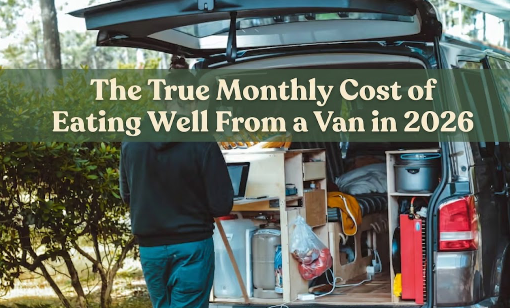
The first time I sat down and tracked every dollar I spent on food for a full month on the road, the number surprised me. Not because it was horrifying. Because it was specific. Twenty-three dollars on a Tuesday afternoon at a petrol station convenience store I’d stopped at without really thinking. Forty-one dollars on produce that week, of which roughly twelve dollars’ worth went off before I used it. A restaurant meal I’d counted as “local food experience” but hadn’t included in the running total.
Before that exercise, I was operating on a vague estimate. The kind of number you arrive at by roughly remembering your grocery shops and deciding it’s probably around that. I think most van cooks do exactly the same, and it’s also why the figures you see online are all over the place. Someone insists they eat well for $180 a month. Someone else puts their spend at $480. Both numbers are presented with total confidence. Neither is wrong, they’re just counting different things.
This is my attempt at a proper breakdown. The real number, what’s behind it, and where the budget leaks without you noticing.
1. The Figure People Quote Is Usually Missing Half the Story
There’s a number that circulates in van life circles, somewhere in the $150 to $220 range for a solo traveller eating well on the road. It sounds achievable. It sounds like proof that van life food is genuinely cheap.
It’s also almost always incomplete.
Here’s what gets left out of that figure on a regular basis.
The initial pantry spend. When you first stock a van kitchen properly, running through oils, spices, dried pulses, rice, pasta, tinned goods, and condiments, you spend $120 to $150 in a single go. That doesn’t repeat every month. Most of those items last weeks or months. But vanlifers who’ve been on the road for a while often still count that early outlay when they talk about their monthly average. Spread over twelve months, it quietly inflates what looks like a regular monthly figure.
Fresh produce waste. Buy a bag of spinach. Use half. Find the rest turning liquid three days later. That’s $2.50 or $3 you spent and didn’t eat. Do that with a few items across a month and you’re losing $25 to $40 in food that never made it to a meal. Most people count what they bought, not what they actually consumed.
Propane and fuel. This gets filed under vehicle costs rather than food costs in most people’s minds, but you’re burning through gas to cook that food. A month of regular cooking uses somewhere between $15 and $30 in fuel depending on climate, cooking style, and how often you’re relying on one burner versus two. That’s part of the true cost of eating from a van, even if it’s not labelled as such.
Eating out drift. One sit-down meal at a local place runs $12 to $20. Four of those in a month is $50 to $80 before you’ve added a single coffee stop or market snack. People who say their van food budget is $200 very often aren’t including restaurant meals because in their heads those are a separate category. They’re not. If you need food to eat, it’s food spend.
Once you count all of it honestly, a solo vanlifer eating well and not suffering ends up somewhere between $370 and $500 per month in 2026. Couples typically land between $550 and $720. Not double, because cooking for two allows for batch cooking efficiency and bulk buying, but not dramatically lower either.
These figures have shifted upward from 2023 and 2024. Grocery inflation across the US, UK, and Western Europe has been real and persistent, and van life food costs moved with it. Anyone quoting you a solid “$200 a month eating well” figure from a 2022 blog post is working from numbers that don’t hold up anymore.
2. The Real Monthly Breakdown in 2026
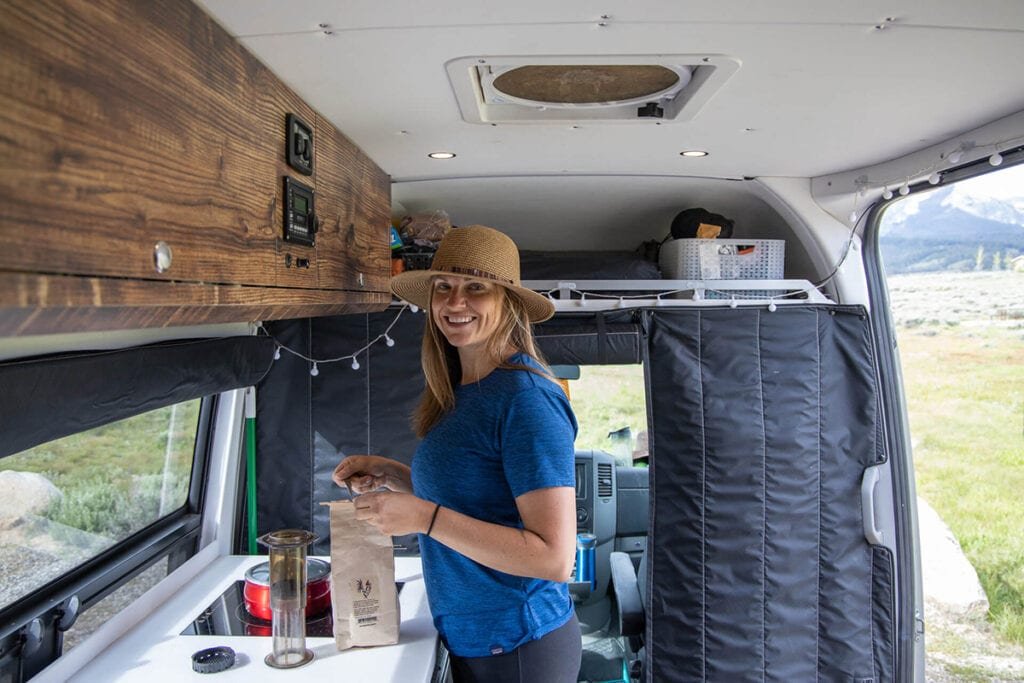
Here’s how the monthly spend actually looks across individual categories, comparing a lean approach with genuinely eating well:
| Food Category | Getting By (Solo/month) | Eating Well (Solo/month) |
|---|---|---|
| Pantry staples (oils, spices, pulses, tinned goods, grains) | $28-$40 | $48-$65 |
| Fresh produce (vegetables, fruit) | $38-$55 | $62-$90 |
| Protein (meat, fish, eggs, legumes) | $44-$65 | $78-$115 |
| Dairy and alternatives | $18-$28 | $28-$48 |
| Bread, pasta, rice | $14-$22 | $20-$34 |
| Snacks, coffee, drinks | $16-$28 | $28-$50 |
| Eating out (occasional) | $20-$45 | $52-$100 |
| Monthly total (approximate) | $178-$283 | $316-$502 |
The gap between the two columns isn’t as dramatic as most people expect. It’s roughly $140 to $220 a month. What that difference actually buys is variety, enough protein to feel properly energised day to day, produce that isn’t scraping the bottom of the budget shelf, and the occasional good meal out without it being a budget crisis.
Pantry staples are the most stable category once the initial setup is done. Over at Van Life Kitchen, there’s a useful breakdown of building full meals from a core eight-ingredient pantry, which is exactly how the “eating well” column keeps that line manageable. When you cook from a proper pantry base rather than buying everything fresh and specific, you spend consistently and waste very little.
Fresh produce is the most volatile. It’s not expensive in itself but the price varies enormously depending on where you are when you need it. A farmers market on a Saturday morning is a different price from a motorway service station at 7pm when you’ve run out of onions. Moving frequently means you’re often buying at the most convenient source rather than the most economical one.
The protein column is where flexibility makes the biggest difference. Eggs, tinned legumes, cheaper cuts of meat, tinned sardines and mackerel: these keep the cost down while still eating well. People who overspend on protein are usually buying the most expensive cuts out of habit, or buying fresh items that go off because they didn’t think through the week’s cooking before they shopped.
3. Where the Budget Bleeds Without You Noticing
There are three places money consistently disappears in van food spending. None of them look like big single expenses. That’s what makes them effective at draining the budget quietly over the course of a month.
Produce waste. This is the most common and most correctable. You buy something fresh, use it partially, and the remainder goes off before you get back to it. Salad leaves, fresh herbs, stone fruit, berries, half an avocado you didn’t need but picked up anyway. These are the items that silently add $25 to $40 of waste per month. The solution isn’t to stop buying fresh food. It’s to shop around shelf life rather than around recipes. Carrots, cabbage, onions, sweet potatoes, firm squash, apples: these hold for a week or more in a cool van. The more perishable items deserve to be bought in small amounts, used immediately, and not restocked until you need them again. The Van Life Kitchen batch cooking guide covers exactly this kind of thinking around shelf life and planning, and it’s worth reading before you do your next big shop.
Premium convenience products. The van life market has identified that people living in vans will pay more for things labelled as convenient and portable. Freeze-dried meals at $8 to $12 each. Pre-portioned spice kits at twice the cost of buying spices separately. Ready-made travel sauces. There are absolutely days when paying a premium for convenience is the right call: exhausted, parked in the dark, zero appetite for cooking. But once those products become regular purchases rather than occasional shortcuts, the monthly spend climbs fast. A solid repertoire of no-fridge van meals you can make from scratch is the real defence against that creep. If you have six or seven genuinely easy, genuinely satisfying meals you can cook in under twenty minutes from your pantry, you reach for the expensive convenience option a lot less.
Restaurant drift. I’ll include this one because I fell into it myself, particularly in the first few months on the road. You’re somewhere interesting. The local place has good reviews. It’s been a long day and the van feels small and cooking feels like too much effort. One meal becomes two that week, two becomes three the following week, and before you’ve noticed it you’re spending $200 to $280 a month eating out and framing it to yourself as “cultural experience.” Eating out should be a deliberate pleasure. One good local meal a week at $15 to $25, something you actually choose because you’re excited about it, is a well-spent $60 to $100 a month and stays controlled. Three or four meals a week because you stopped cooking is a different conversation.

4. The Part Nobody Really Talks About: What the Extra Spend Is Buying You
There’s an instinct, when you see your food budget is higher than you expected, to start cutting. Sometimes that’s the right call. Often, people cut in the wrong places and the actual quality of their life on the road drops significantly without the savings being worth it.
The meaningful difference between the “getting by” column and the “eating well” column in that table lives almost entirely in two categories: fresh produce and protein. These are the two things that most directly affect how you feel. Cheap carbs and tinned goods will keep you full. Adequate protein and genuine vegetable variety will keep you energised, sharp, and actually enjoying your cooking. The $62 to $90 produce budget versus the $38 to $55 one sounds like a jump but in daily terms it’s the difference between cycling through the same five cheap vegetables all month and having a diet you actually look forward to.
For getting the most out of that budget, meal prep for solo van travellers is the approach that works consistently. One proper cook session a week, building component batches rather than whole meals, gives you four or five days of flexible eating from a single effort. The portion sizing for solo cooking is specific, it’s not just “halve a normal recipe,” and getting it right reduces both cost and waste at the same time.
If I were setting a tight budget and needed to find savings somewhere, the first cut I’d make is snacks and drinks. Not fresh produce, not protein. The bought-in trail mixes, the daily coffee shop stops, the sparkling water habit, the overpriced supermarket sandwiches bought because you didn’t have something ready. Shaving $25 to $35 from that category costs you nothing that actually matters to how well you eat. That’s the cut worth making before you start compromising on the food you cook and sit down to eat properly.
FAQs
Can you realistically eat well for under $300 a month as a solo van traveller in 2026?
In lower-cost countries, yes. In Western Europe, the US, Canada, or Australia, it’s tight. You can eat adequately for $260 to $290 in those places, but adequately means a narrow rotation of cheap ingredients, limited protein variety, and not much fresh produce beyond the basics. Eating well with genuine variety and enough protein to feel good generally starts around $320 to $350 per month before you include any eating out at all.
What’s the single biggest driver of the gap between a $250 food budget and a $450 one?
Eating out frequency, almost always. The person spending $450 typically includes two or three restaurant meals a week without fully counting them as food spend. The person at $250 is cooking nearly every meal and being deliberate about shopping. The gap isn’t about whether one person eats better food. It’s usually about how much cooking actually happens.
Does having a van fridge make a real difference to the monthly budget?
Yes, significantly. A decent 45-litre fridge lets you buy in larger quantities at better prices, store leftovers properly, and use a wider range of fresh ingredients without waste. Cooking without cold storage forces more frequent small shops at whatever’s convenient, higher per-meal costs on perishables, and more reliance on tinned and shelf-stable options which are often more expensive than the fresh equivalent bought in bulk. The monthly difference between cooking with a good fridge and cooking with no cold storage at all can be $50 to $75 over a full month.
How much does the ongoing pantry maintenance actually cost once you’re set up?
Less than most people expect. Once the initial setup spend is done, maintaining a well-stocked van pantry runs around $42 to $60 a month for a solo cook. That covers topping up oils, replacing spices, keeping tinned goods restocked, and replenishing dried pulses, grains, and pasta as they run down. The key is treating the pantry as a rotating resource rather than a weekly shopping list. Most pantry items don’t need buying every week. You’re just replacing what you’ve actually used.
Is van life food spending genuinely cheaper than cooking at home in a flat or house?
For people who were eating out frequently or living somewhere with high rent and high local food costs, yes. For people who were already careful home cooks with good supermarket access, the monthly food spend is often comparable. The real financial benefit of van life isn’t dramatically cheaper groceries; it’s a lower overall cost of living that means the food budget can be properly funded without financial strain. The cooking itself can be just as good, and honestly, a lot of the time it’s better because you’re choosing where you park.
The month I tracked everything properly, my actual figure was $398. A few dollars under $400 for a solo traveller eating real food, cooking properly most evenings, and treating myself to one sit-down meal a week somewhere I genuinely wanted to eat. That felt like good value. It also felt like the honest number, not the optimistic estimate. Getting to grips with what the real cost is, rather than the one you hope it is, turns out to be one of the more useful things you can do before the money starts running away from you on the road.